Deck Size Guide: Proper Dimensions for Patio Furniture
You’ll need at least 36 inches of clearance around dining furniture and 42–48 inches for accessibility pathways. A standard dining area requires 300 square feet for six to eight people, while lounge spaces need 150–200 square feet minimum. For grilling, allocate 100–150 square feet with an 8-foot minimum width. Multi-activity decks benefit from 500–800 square feet with clear zoning between functional areas. Understanding these dimensions guarantees you’re maximizing your outdoor layout effectively.
Understanding Standard Deck Dimensions
When you’re planning a patio deck, you’ll need to start with the right dimensions. Understanding deck shapes and deck sizes helps you maximize your outdoor space efficiently.
Standard rectangular decks commonly measure 15×20 feet or 18×20 feet, offering practical layouts for most homes. Square decks typically run 18×18 feet or 20×20 feet. If you’re working with limited space, compact 10×10 feet designs work well. Larger properties benefit from 20×30 feet or 25×25 feet configurations.
Most decks are wider than they’re deep, with the longer dimension running along your house. This orientation optimizes views and natural traffic flow. Average residential decks range from 300 to 400 square feet, providing adequate room for furniture and movement. To ensure your deck is built to your specifications and vision, consider obtaining a written contract with your contractor that details the scope, materials, timelines, and payment terms. For outdoor furniture on your deck, larch wood offers excellent durability and weather resistance, making it a sustainable choice that can last for decades with proper maintenance. Consider your intended use—dining, lounging, or entertaining—when selecting your specific dimensions.

【Built to Handle the Outdoors】Made with handwoven all-weather wicker over a sturdy steel frame, this sectional is designed for everyday outdoor living. The weather-resistant materials stand up well to sunshine, light rain, and changing seasons, helping your patio stay inviting year after year.

CUSHIONED SOFA: Looking for something more refined in your outdoor space? This sofa fulfills with comfy cushions and eucalyptus wood that's protected to weather the elements with ease

Quality and Durable: founded atop a powder-coated steel frame, wrapped in dense all-weather wicker with woven details closely in a black finish with stereo arcuate stripe for a tastefully textured, cozy look, makes outdoor furniture set 3 PCS exceptionally durable
Applying the 20% Rule to Your Home
Now that you’ve determined your deck’s dimensions, you’ll want to contemplate how to allocate your overall home improvement budget effectively. Consider dedicating approximately 20% of your total home improvement budget to outdoor living spaces, including your deck and patio furniture. This allocation prevents over-investing in a single element while maintaining budget flexibility for other essential projects.
Your financial strategy should reflect your specific circumstances rather than rigidly adhering to the 20% benchmark. If you’re in a high-cost market or have tighter constraints, adjust accordingly. The principle emphasizes proportionality—ensuring you don’t overcrowd your deck or exhaust resources on furniture alone. To ensure your furniture arrangement complements your deck’s structural integrity, verify that baluster spacing meets safety requirements for your household. Before finalizing your furniture placement, ensure your deck meets New Jersey railing codes to maintain both safety compliance and proper spacing for your seating arrangements. By applying this balanced approach, you’ll optimize both your outdoor functionality and overall home value without compromising your financial stability or creating spatial constraints.
Choosing the Right Dining Furniture for Your Space
How do you select dining furniture that fits both your deck dimensions and entertaining needs? Start by measuring your available space and calculating clearance requirements—you’ll need at least 36 inches around your table for comfortable movement. Consider table shapes carefully: rectangular tables maximize seating in narrow spaces, while round tables work well for intimate gatherings and conversation.
Next, match your table size to your guest count. A 36×48-inch rectangular table seats four; a 36×72-inch seats six. Account for furniture materials that withstand your climate—weather-resistant wood, metal, or composite materials offer durability. For dining spaces, plan for an extra 3 feet on all sides of the table to accommodate chair movement and foot traffic.
Finally, ascertain chairs fit proportionally. Standard dining chairs require approximately 3 square feet each. Verify that you can pull chairs out fully without obstructing walkways or doors. Ensure your deck’s structural integrity and post spacing can support the weight of furniture and guests. This strategic approach guarantees functional, proportionate outdoor dining spaces.
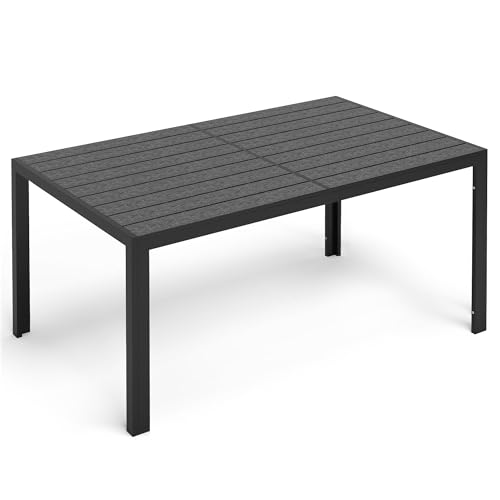
Rust and Weather Resistant: Crafted with premium-grade galvanized steel and zinc-coated metal framing, this patio dining table resists rust, corrosion, and harsh weather. Advanced galvanization technology ensures long-lasting durability for year-round outdoor use.
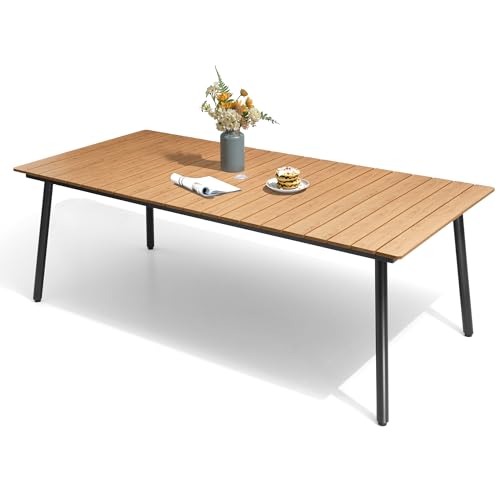
Generously Seats 8 with Ample Elbow Room: Our 82.7" x 40.6" dining table(Top length: 6.89 FT) comfortably accommodates 8 people, providing plenty of personal space. The sturdy construction reliably holds up to 165 lbs, perfect for family meals and entertaining.

General to fit square/round patio table with 6-8 standard chairs size up to 94"(L)x94"(W). Measure your patio furniture dimensions before buying, and include chair clearance in your measurements.
Planning Essential Clearance and Traffic Flow
Once you’ve selected your dining furniture, you’ll need to map out traffic flow patterns across your deck to maximize both functionality and safety. Start by measuring your deck’s exact dimensions and identifying fixed features like railings and built-in seating. Document door locations and level changes to define primary circulation paths.
Maintain at least 36 inches of clearance for general traffic flow and increase to 42–48 inches in wheelchair-accessible areas. Plan your furniture arrangement to preserve unobstructed pathways between functional zones. Allow 3 feet around dining tables for comfortable chair movement. In high-traffic areas, allocate 60-inch diameter turning spaces for maneuverability. Arrange furniture pieces with sufficient spacing to prevent crowding while maintaining clear, direct routes from doorways to functional areas. Proper joist spacing underneath your deck ensures the structural support necessary to safely accommodate furniture placement and foot traffic. Before finalizing your furniture layout, ensure your deck structure is sound by addressing any damaged screw heads or fastener issues that may compromise the integrity of your decking surface.

[What You Get] - The package comes with 3 Pcs Flat Washer. Inner Dia: 20mm/0.79inch; Outer Dia: 36mm/1.42inch; Thickness: 3mm/0.12inch.

Great for Wooden Board, Decks and Dock : Needs 3/16" - 1/4" of spacing between decking boards, The Decks max thickness of 1.5 inch. Strong deck anchor set can protect your valuable outdoor furniture, kayaks and SUP boards in bad weather! Outdoor furniture deck anchor can create a firm and secure grip! Secure your outdoor furniture or any goods to deck.

Functionality: the deck spacers feature either 1/8" or 3/16" shim edges; It spaces deck lumber apart to allow for adequate expansion and contraction to minimize guesswork; The efficient design of this decking tool ensure not only a visually appealing finish but also a solid foundation, elevating the quality and durability of your decking endeavors
Selecting Lounge and Casual Seating Options
After establishing your traffic flow patterns, you’ll want to select lounge chair styles and casual seating that fits your deck’s dimensions and complements your dining area. Standard lounge chairs range from 20–25 inches wide and 20–24 inches deep, requiring 24 inches of side clearance for access. For compact alternatives, consider chairs measuring 25–30 inches wide by 35–40 inches deep. Casual seating squares offer flexibility at 16–25 inches wide with 16–18 inch depths. Evaluate casual seating materials based on your climate and maintenance preferences—weather-resistant fabrics and powder-coated metals withstand outdoor conditions effectively. Match seat heights (15–18 inches) across all pieces for visual cohesion. This coordinated approach maximizes comfort while optimizing your available deck space.

2 adjustable zero-gravity outdoor chairs in Beige provide a weightless feel for optimal relaxation

Portable & Foldable Design: Lightweight outdoor folding chair weighs only 15.43 lbs. This Sweetcrispy zero gravity recliner can be quickly folded and assembled for easy portability, perfect for the beach, camping trips, lawns, poolsides, and other outdoor activities

LOCKABLE RECLINING SYSTEM: Smoothly glides into an ergonomic zero-gravity position, with removable elastic cords that immediately adjust to your body's weight
Calculating Occupancy Capacity for Gatherings
Understanding your deck’s occupancy capacity guarantees you’ll host gatherings safely and comfortably while adhering to building codes. You’ll base occupancy calculations on your deck’s total square footage and intended use. For unconcentrated assembly areas, apply 15 square feet per occupant. A 12×16 deck, for example, accommodates approximately 10 people comfortably with a maximum of 15. Your deck safety depends on proper exit planning—occupant loads between 1 and 500 people require minimum two exits. You must also consider furniture arrangement, as dining tables and seating configurations impact actual capacity. Get local authority approval for your occupant load designation. These calculations confirm your deck meets code requirements while providing guests adequate space for safe, functional gatherings.
Sizing Your Deck for Specific Activities
Now that you’ve determined your deck’s overall occupancy capacity, you’ll need to allocate space for the specific activities you’re planning. Smart space optimization requires dedicating distinct zones for dining, lounging, and cooking within your deck layout.
For dining, reserve 300 sq ft for six to eight people with comfortable seating. Allocate 150–200 sq ft for lounge areas with minimum 12 ft dimensions. Your grilling space requires 100–150 sq ft with 8 ft minimum width and 3 ft clearance behind the grill.
If you’re incorporating a fire pit, dedicate 100–150 sq ft with an 8 ft diameter minimum and 3 ft safety clearance. Multi-activity decks spanning 500–800 sq ft benefit from clearly separated zones and 20 sq ft per person for traffic flow between areas. Ensuring proper post hole depth beneath deck support structures will provide the stability needed to safely support multiple activity zones and the furniture and people using them.
Maximizing Functionality in Limited Spaces
When you’re working with a limited deck space, you’ll need to prioritize functionality over quantity. Select multi-functional pieces that combine seating and storage—benches with compartments and ottomans serve double duty while reducing clutter. Opt for lightweight, slim-profile furniture that maintains visual openness without sacrificing usability.
Implement space-saving solutions through vertical storage: wall-mounted shelves, hanging planters, and outdoor cabinets keep accessories accessible yet organized. Arrange furniture into distinct functional zones using rugs, planters, or dividers to guide traffic flow and prevent overcrowding. Position your longest piece along the longest wall to anchor the space.
Incorporate modular, folding, or stackable furniture for flexible reconfiguration based on your needs. This functional aesthetics approach maximizes usable square footage while maintaining comfortable pathways and organized activity areas. Ensure your deck layout complies with local building codes regarding railing height and safety requirements to create a secure outdoor environment.
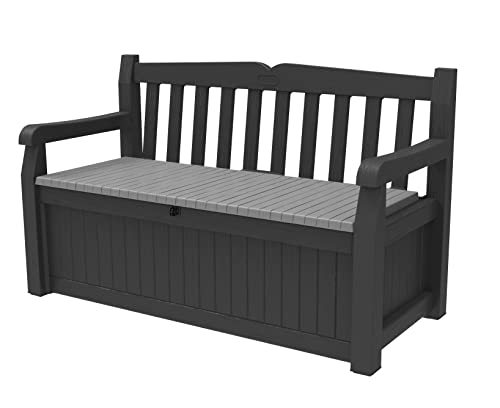
IDEAL SIZE: Exterior: 54. 6 in. L x 23. 4 in. W x 32. 8 in. H / Interior: 50. 4 in. L x 19. 7 in. W x 15 in. H

DIMENSIONS: Exterior: 50.4 in. W x 21.2 in. D x 23.2 in. H / Interior: 49.6 in. W x 20 in. D x 22.8 in. H

DIMENSIONS – Compact Yet Spacious for Small Spaces: Exterior: 45.9" W x 17.4" D x 22.2" H / Interior: 44.6" W x 15.6" D x 20" H — a perfect fit for balconies, patios, porches, and small outdoor areas.