
How Much Space You Need for Patio Furniture: A Guide
You’ll need at least 36 inches of clearance around dining tables and 24 inches between individual chairs for comfortable movement. Maintain 18 inches minimum from walls for standard seating, while high-traffic pathways require 3-4 feet of open space. Plan 20 square feet per person for social gatherings. Glider chairs demand 30 inches from walls plus 14-16 inches on sides. Chaise lounges need 24 inches of clearance around them for accessibility. These measurements form your layout foundation, though zone-specific requirements reveal additional spacing nuances.
Understanding Minimum Clearance Requirements
You’ll need to establish precise clearance measurements to create a functional outdoor space that accommodates both movement and comfort. Standard patio layouts require 3 feet of clearance around chairs for unobstructed access and movement. Space individual chairs approximately 2 feet apart to prevent collisions. When planning furniture arrangements, maintain a 7-inch gap between chair arms and table aprons for seamless sliding.
For dining areas, guarantee 3 feet of clearance around tables, with an additional 72 inches allocated for seating on each side. High-traffic walkways demand 3 feet minimum, preferably 4 feet, to facilitate smooth passage. To maintain your furniture investment within these optimized spaces, implement protective covers to shield against weather damage and extend furniture longevity. These measurements form the foundation of ergonomic patio design, enabling you to optimize spatial efficiency while maintaining accessibility and comfort throughout your outdoor environment.
Calculating Space Between Furniture and Walls
While clearance around furniture pieces establishes comfortable movement within your patio, the relationship between your furniture and the perimeter walls demands equally precise measurement.
You’ll want to maintain minimum wall clearance of 18 inches for standard seating, allowing adequate access to chairs. However, your furniture arrangement requires strategic spacing adjustments based on chair type. Glider chairs demand 30 inches from wall to chair back, plus 14–16 inches on sides. For high-traffic pathways adjacent to walls, allocate 3–4 feet of clearance. Low-traffic areas can function with 2–2.5 feet.
Consider architectural features like railings or built-in elements that reduce effective clearance. Wheelchair accessibility demands 36 inches minimum between seat backs near walls. Measure carefully, accounting for all obstructions that impact safe, comfortable navigation around your patio space.
Designing High-Traffic Pathways
Strategic pathway design determines how efficiently guests navigate your patio while maintaining comfort and safety. You’ll want to establish minimum widths of 30 inches for high-traffic zones, though 36–48 inches proves ideal for unrestricted movement. Around pools and grills, expand pathways to 4–5 feet for safer maneuvering.
Direct traffic flow around seating areas rather than through them using buffers, dividers, or planters. This prevents bottlenecks at critical points like doors, pools, and grills. Select pathway materials offering non-slip surfaces on level ground to eliminate tripping hazards. For patios with overhead structures, ensure beams and supports are properly sized—engineered lumber like LVL can safely span long distances without excessive sagging, preventing overhead hazards.
Connect key functional areas strategically—house, patio, grill, pool—with clear, unobstructed routes. Define edges with contrasting materials or lighting to guide guests effectively. Consider applying mildew-resistant finishes to your pathway surfaces to maintain safety and appearance throughout seasonal weather changes. This intentional approach maximizes usability while minimizing congestion during gatherings.
Dining Table Layout and Spacing Standards
Because dining tables anchor your patio’s functionality, selecting the right dimensions and spacing directly impacts both comfort and flow. Your dining table dimensions must align with your seating capacity and available space. A 48-inch round table accommodates 4 people, while 54-inch and 60-inch rounds seat 5–6 and 6–8 people respectively. Rectangular options range from 72 inches for 6 people to 84 inches for 8 people.
Clearance matters equally. Maintain at least 36 inches between your table and surrounding elements for comfortable movement. High-traffic areas demand 3 feet minimum, though 4 feet or more optimizes circulation. This spacing prevents congestion and guarantees guests navigate smoothly around your dining setup. Before placing your furniture, ensure your patio surface is properly prepared with deck coating to create a durable foundation that will support your dining arrangement. For social gatherings, plan for approximately 20 square feet per person to ensure adequate space for all attendees on your patio.
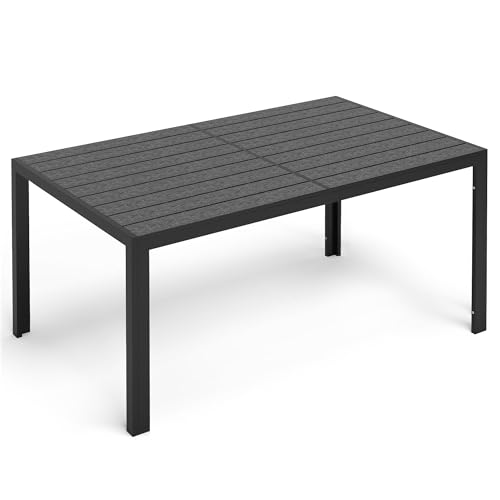
Rust and Weather Resistant: Crafted with premium-grade galvanized steel and zinc-coated metal framing, this patio dining table resists rust, corrosion, and harsh weather. Advanced galvanization technology ensures long-lasting durability for year-round outdoor use.

Practical Patio Dining Set: A classic nature-inspired patio table and chair set is the beautiful addition to your outdoor space. The dinette with a table and 6 chairs is perfect for gathering and just enjoying a relaxing time with family and friends in the garden, patio.

【CAST ALUMINUM】 : Using high-density pure aluminum die-casting, to ensure the strength of the table and chair, no cracking, no deformation, no rust, smooth lines, beautiful appearance.
Optimizing Chair Placement Around Tables
Once you’ve established your table dimensions and clearance zones, chair placement becomes the critical variable that determines whether your dining area functions as an efficient, comfortable space or feels cramped and awkward.
You’ll want to maintain 24 inches between each chair’s front edge and your table to guarantee comfortable seating and standing movement. For seating arrangements, space chairs evenly around the table, allowing at least 24 inches between individual chairs. This spacing prevents crowding while supporting natural conversation flow.
Consider L-shaped or curved layouts that direct sightlines inward, fostering genuine interaction among guests. You’ll enhance conversation flow further by facing chairs toward the center rather than against walls. Confirm your arrangement permits traffic movement around the seating area without disrupting the dining experience.
Selecting the Right Lounge Size for Your Patio
How do you choose a lounge that fits both your space and your body? Start by measuring your patio dimensions against lounge specifications. Small lounges measure 50 inches, medium range from 60-65 inches, and large extend to 75 inches. Standard lounge chairs span 25-30 inches wide with 35-40 inch depths.
Next, consider ergonomic requirements. Seat heights of 15-18 inches guarantee comfortable positioning, while 20-25 inch widths accommodate various body sizes. Depths of 20-24 inches provide proper leg support. Armrests add 2-3 inches to overall width.
Match these dimensions against your available space. A single lounge requires 4 by 7 feet minimum. Two lounges demand 7 by 7 feet. This precision prevents purchasing oversized furniture that disrupts space aesthetics and circulation pathways while selecting lounge styles that balance functionality with your patio’s proportions.

✨【Waterproof & UV Resistant】: Outdoor chaise lounge chair cushion is made of high quality waterproof fabric, effectively prevent rainwater from seeping into the padding, while featuring UV protection to prevent fading under sun exposure. Ensures your outdoor chaise lounge cushion stays like new, perfect for poolside, patio and other outdoor scenarios. Not recommend to left outside in rainy days and cover when not use to prolong their using time.

Size & Colour: Our chaise lounge cushions outdoor feature seat cushion dimensions of 44L×21W×3H inches and backrest dimensions of 28L×21W×3H inches. Before purchasing, please carefully measure your lounge chair to ensure a proper fit. Additionally, the lawn chair cushions are available in a variety of colors to suit your personal style. These versatile chase lounge cushions enhance your comfort whether you're relaxing by the pool, on the patio, balcony, courtyard, backyard, or at the beach

UPGRADED COMFORT: Built with durable and breathable web, the beach chair is comfortable enough to use in every season. Updated higher backrest gives you more support when you lean back
Deep-Seat Lounges and Additional Space Considerations
Deep-seat lounges demand considerably more space than standard patio furniture, requiring you to recalibrate your layout planning. These deep seat styles typically occupy 35 to 40 inches overall depth, with seat widths spanning 24 to 30 inches. You’ll need to maintain 32 to 36 inches of clearance around each lounge for comfortable circulation and access.
Strategic spacing proves critical for functionality. Position lounges 6 to 12 inches from walls to guarantee airflow and prevent moisture damage. Allow 18 inches between seating and coffee tables for movement. Additionally, allocate dedicated cushion storage space near your lounges—this prevents clutter while protecting seasonal cushions from weather exposure. Proper cushion storage also helps you maintain your outdoor furniture by keeping cushions dry and ready for air-dry in direct sunlight treatments if mold develops. Consider using covered storage solutions with proper drainage slope to direct water away from stored cushions during heavy rainfall.
Plan your patio footprint carefully before purchasing. Measure available dimensions and account for auxiliary furniture. This precision approach guarantees your deep-seat lounges enhance rather than compromise your outdoor living experience.
Chaise Lounges: Length, Width, and Accessibility
While deep-seat lounges prioritize recessed comfort, chaise lounges demand different spatial considerations that center on length and accessibility for full-body reclining. You’ll need approximately 78 to 79 inches of length for proper recline support, paired with 27 to 30 inches of width. Your seat height at 12 inches facilitates easy entry and leg extension, while the 37 to 38-inch backrest height guarantees ergonomic support.
Cushion thickness ranging from 2 to 5 inches influences overall dimensions without compromising function. You should plan for at least 24 inches of clearance on sides and foot ends for movement. Chaise lounge materials and their weight affect repositioning accessibility. Measure end-to-end and side-to-side, accounting for adequate space around your furniture to prevent congestion and affirm comfortable circulation. If your chaise lounge sits on a deck, ensure the deck structure meets Massachusetts deck code requirements to safely support the furniture and users.
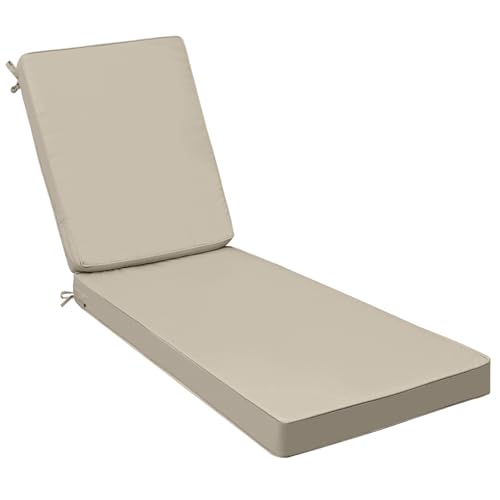
About Size: Seat 47×20×3", Back 31×20x3". Be sure to measure your chair seat before buying; if size difference is over 0.5", think twice. Designed to add comfort and a fresh look to your chairs. Assembly is required

UNIVERSAL FIT CHAISE LOUNGE COVER: Measured with 78L x 34W x 32H inch, fits Patio lounge chair. Please measure your sofa carefully before purchasing

[CHAISE LOUNGE]: SAFAVIEH Cam Chaise Lounge is a sun lounger that suits the poolside, patio, deck, sun deck or backyard, long enough to lie out full length rather than sit back.
Coffee Tables and Occasional Furniture Placement
Because coffee tables and side tables anchor your patio’s functional layout, you’ll want to prioritize their dimensions and placement to maintain both accessibility and visual proportion. Your coffee table should measure approximately two-thirds of your sofa’s length, maintaining 18-24 inches of clearance around it for comfortable movement. Position it directly in front of your main seating piece, aligned with sight lines.
Side tables serve distinct side table functions—holding drinks, books, and accessories within arm’s reach. They’re typically 18-24 inches wide and match your armrest height for effortless placement. Select weather-resistant materials like teak or powder-coated aluminum to guarantee durability. Just as deck wood protection requires careful material selection to ensure longevity, choosing high-quality patio furniture materials will extend the life of your outdoor pieces. Materials like cast aluminum offer exceptional durability and rust resistance, making them excellent choices for long-term outdoor use.
Coffee table styles range from rustic wood to sleek modern designs, offering versatility. Features like lower shelves or drawers enhance functionality without consuming additional floor space, maximizing your patio’s usability.
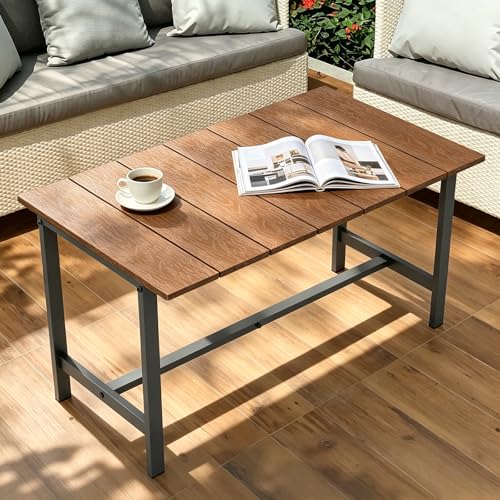
Weatherproof Wood Tabletop: Crafted with rustic brown wood-grain surface top featuring excellent waterproof & UV-resistant performance, no cracking, fading or rotting under long-time outdoor sun/rain exposure; textured wood-look matches rattan sofas & various patio decor perfectly

Quality and Durable: all-weather HDPE wicker and anti-rust steel frame make this wicker outdoor table very durable and sturdy. No worry about rust, water, split, crack, and fade, superbly ensure to last a long time
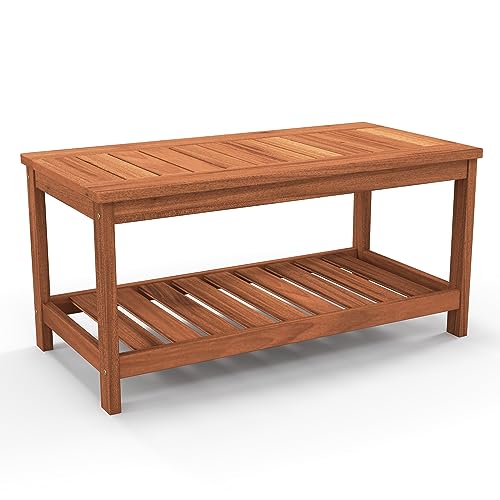
2-Tier Storage Space: The 2-tier coffee table consists of a spacious tabletop and extra storage shelf, providing ample space for casual dining to enjoy chatting with family or entertain your guests. You can hold books, cups, fruit tray, ornament, and so on neatly for easy fetching.
Planning Multiple Functional Zones in One Space
To maximize your outdoor space’s potential, you’ll need to assess each zone‘s primary purpose—whether you’re designing for dining, relaxation, or hosting social gatherings—since this determination directly shapes your furniture selection and layout strategy.
Dividing your backyard into distinct zones prevents overcrowding while establishing clear zone functionality. Implement natural dividers like outdoor rugs, planters, and pergolas to create visual separation without physical barriers. These elements maintain coherent outdoor aesthetics while defining seating areas, dining stations, and lounging corners. Pergolas can support climbing plants to further enhance your garden’s visual appeal while providing customizable shade. Ensure your zone dividers comply with local building codes to maintain safety standards in your outdoor layout.
Strategic pathways guide movement between zones, ensuring comfortable circulation. Position furniture to encourage conversation while preserving open walkways. Consider modular sofas and extendable tables that adapt to varying zone demands. Properly scaled pieces complement your design without overwhelming usable space, creating organized sections that serve specific purposes flexibly.

Modular & Outdoor Sectional: The 7-piece patio sectional couch offers unrivaled flexibility. Its modular design lets you freely assemble the components into diverse configurations. Whether you want a cozy U - shape for an intimate chat, a linear setup along the pool, or an L - shape for a garden corner, the choice is yours. You can easily customize the combination according to your patio's layout, your intended outdoor activities, and your personal preferences. This outdoor sectional couch empowers you to transform your outdoor space at will

Durable materials: PE rattan wicker has good performance in high tensile strength, durable but light-weight,Fully hand-woven smooth exquisite anti-aging protective, Handwoven with precision, the rattan is fade-proof, and weather-resistant, ensuring it withstands harsh sunlight, rain, and daily use. The elegant design enhances any outdoor space, from modern patios to rustic gardens

Thickened Cushions:Experience unmatched relaxation with upgraded 4-inch thick seat cushions and ergonomic back cushions. Crafted with high-density upright fiber cores, these cushions provide optimal support and resilience, ensuring they retain their shape even with prolonged use. Designed for both comfort and durability, the water-resistant cushion covers are easy to clean and maintain, making this patio furniture set perfect for outdoor living.


