

What Size Nails for Deck Boards: A Complete Guide
You’ll need to match nail size to your decking thickness: use 8d nails (2.5 inches) for half-inch material and 10d nails (three inches) for five-eighths-inch decking. Ring-shank nails provide superior holding power compared to smooth-shank alternatives, especially during seasonal temperature changes. Select galvanized or stainless steel for corrosion resistance based on your climate. Proper fastener selection prevents withdrawal and structural failure. The specifics of each consideration deserve closer examination.
Understanding Nail Penny Size Designations
When you’re selecting nails for deck boards, you’ll encounter the “penny size” system—a designation that’s been standardized in construction for centuries. The abbreviation “d” derives from the Roman denarius coin, historically indicating how many nails you could purchase for a penny. Today, penny size exclusively denotes nail length rather than price or quantity.
Understanding nail length standards is critical for deck construction. The relationship is straightforward: as penny size increases, so does nail length. Common sizes include 8d nails at 2.5 inches and 16d nails at 3.5 inches. This penny size history provides you with a quick reference system that guarantees you’re selecting appropriately sized fasteners for your deck boards’ specific requirements and structural demands.

Perfect nail for deck, patio, fence, and other outdoor construction

16-D (3-1/2") Galvanized Spiral Deck Nails (1 lb.)

Perfect nail for deck, patio, fence, and other outdoor construction
Material Composition and Corrosion Resistance Options
Selecting the right nail length sets you on the path to proper fastening, but your choice of material matters equally for long-term deck performance. When comparing nail materials, you’ll find galvanized and stainless steel dominate outdoor applications. Galvanized nails offer reliable corrosion resistance through zinc coating, while stainless steel provides superior protection but reduced gripping power. For specialty decking like cedar or redwood, aluminum nails prevent galvanic reactions that cause discoloration. Copper nails deliver exceptional durability in harsh coastal environments, though cost limits their use. For premium cedar installations, 316 stainless steel edge screws are specifically recommended to prevent tannin staining and ensure long-lasting performance. Selecting corrosion resistance depends on your climate and wood type. Coated technologies—cement, vinyl, and adhesive—enhance holding power and moisture protection. Just as proper brush care with solvent cleaning methods preserves your tools’ performance for future projects, maintaining your fasteners’ integrity ensures your deck’s structural longevity. Match your material choice to local conditions and deck board composition for prime longevity and structural integrity.

[What You Get] - Package content comes with 50 pieces of 304 stainless steel spiral deck nails. Total Length: 25mm / 0.98inch; Head Diameter: 5mm / 0.2inch; Rod Diameter: 2.2mm / 0.09inch.
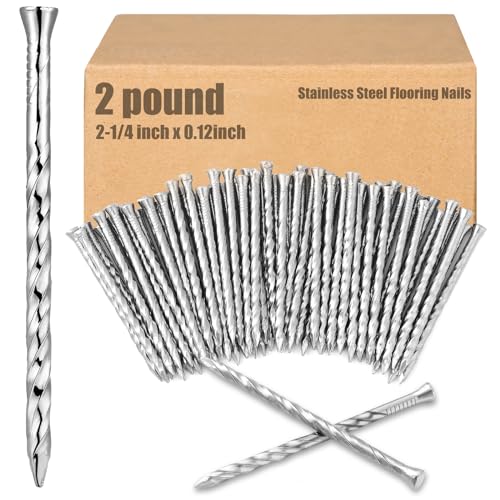
Comprehensive Package: this package includes 1 pack 300 pcs of hardened flooring nails, providing a generous amount to carry several projects; Whether you are working on a big project or you need a few nails for small tasks, this pack got you covered

Total Length: 32mm / 1.26inch ; Shank Diameter: 2mm / 0.08inch
Shank Design and Holding Power Differences
Beyond material selection, the nail’s shank design fundamentally determines how well it’ll hold your deck boards in place. You’ll find ring shank nails deliver twice the withdrawal strength of smooth alternatives, making them ideal for decking applications. The grooved design locks wood fibers in place, preventing boards from pulling up over time—a critical concern in deck construction.
Screw shank nails offer comparable holding power to screws through their threading action, requiring more driving force but providing superior pull-through resistance. Your fastening techniques should account for these shank characteristics: ring shanks work exceptionally well for standard decking, while screw shanks excel in high-wind zones where structural stability demands maximum holding power.

Perfect nail for deck, patio, fence, and other outdoor construction

GREAT FOR HOME CONSTRUCTION USE: Common applications include decks, patios, general construction, and framing

Approximately (95) nails/lb
Matching Nail Size to Decking Material Thickness
Your decking material’s thickness directly determines which nail size will provide adequate structural support and long-term holding power. For 1/2-inch plywood or OSB decking, you’ll need 8d common or ring-shank nails measuring approximately 2.5 inches. If you’re installing 5/8-inch material, upgrade to 10d nails at roughly 3 inches in length. These nail length considerations guarantee proper penetration into joists while maintaining material compatibility. Thicker materials demand proportionally larger fasteners to prevent fastener failure and guarantee structural integrity. Ring-shank nails grip better than smooth-shanked alternatives as deck boards dry and weather over time. However, many experts recommend screws for decking boards because they provide superior tensile strength and prevent boards from warping or popping up over time. By matching nail specifications to your decking thickness, you’ll achieve ideal holding power and durability for your project.

CLASSIC DESIGN: These siding nails by Simpson Strong-Tie are given a diamond point for easy driving, the most common point type in most hardware. These are manufactured with a head diameter of 0.092 inches, and length of 2-1/2 inches.


Simpson Strong-Tie T810ARN5 - 2-1/2" x .131 316SS Ring-Shank Roof Nail 455ct
Ring-Shank Nails vs. Smooth-Shank Nails for Deck Applications
When you’re fastening deck boards, the choice between ring-shank and smooth-shank nails greatly impacts your project’s longevity and performance. Ring-shank nails provide twice the withdrawal resistance through their textured design, which locks into wood fibers. They’re ideal for permanent deck installations where movement and vibration occur.
For installation tips, expect ring-shank nails to require slightly more driving effort, but they’ll resist loosening as wood expands and contracts seasonally. Smooth-shank nails are easier to install and remove, making them suitable only for temporary applications.
When considering cost comparison, ring-shank nails cost more upfront but justify the expense through superior durability and minimal maintenance. Smooth-shank nails are budget-friendly for non-structural projects. Building codes typically mandate ring-shank nails for decking in high-wind or seismic zones.

Seeking framing nails that combine strength, compatibility, and long-lasting performance for your construction projects? Our 21 Degree Framing Nails deliver professional-grade reliability and efficiency!
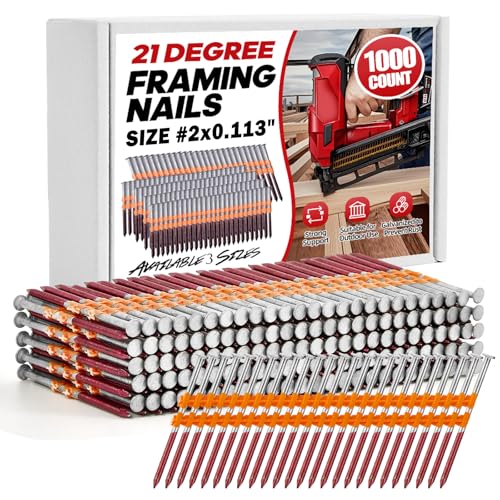
Seeking framing nails that combine strength, compatibility, and long-lasting performance for your construction projects? Our 21 Degree Framing Nails deliver professional-grade reliability and efficiency!

Suitable for Large Projects – Each pack includes 1000 21-degree framing nails (2 in x 0.113 in), making them perfect for contractors and DIY enthusiasts. Supports large-scale construction and woodworking jobs, saving time with an ample nail supply.
Long-Term Performance and Maintenance Considerations
Most deck failures don’t stem from initial installation but rather from fasteners that can’t withstand years of seasonal movement and environmental exposure. You’ll notice that ring-shank nails greatly outperform smooth-shank alternatives during seasonal changes, when wood dimensional shifts reach 1-2% in width. As your deck boards dry and contract throughout temperature cycles, annular ring designs grip wood fibers effectively, preventing the nail head popping that plagues smooth-shank fasteners.
Your deck maintenance becomes considerably easier with proper fastener selection. Ring-shank configurations reduce withdrawal frequency over 10+ year periods, minimizing the constant re-fastening smooth-shank nails require. When ring-shank nails do eventually require removal, using appropriate removal tools like a cat’s paw or nail puller helps preserve your deck boards for potential reuse. Regular maintenance practices, such as cleaning bird baths and feeders and removing debris buildup, also contribute to your deck’s longevity by preventing moisture accumulation and environmental damage. Paired with galvanized or stainless steel coatings matched to your wood’s corrosion resistance rating, these nails maintain structural integrity through repeated seasonal changes without premature degradation or fastener failure.


