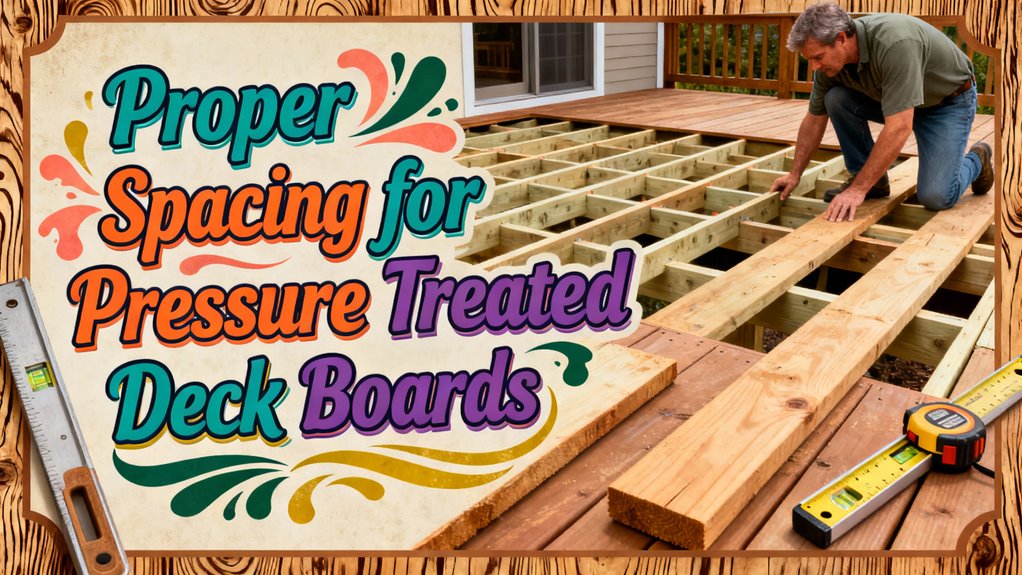
Proper Spacing for Pressure Treated Deck Boards
You’ll space pressure-treated deck boards 1/8″ to 1/4″ apart to accommodate moisture movement and prevent warping, rot, and fastener failure. Use 16D nails as temporary spacers between boards during installation, then remove them after fastening. For KDAT wood, maintain 3/16″ spacing on 4″ boards and 1/4″ on 6″ widths. Wetter climates demand wider gaps, while arid regions tolerate tighter spacing. This spacing strategy protects your deck’s structural integrity while promoting critical airflow and drainage beneath the surface.
Understanding Moisture Content and Wood Behavior
Since wood naturally absorbs and releases moisture in response to changes in relative humidity, you’ll need to understand how this hygroscopic behavior affects your deck boards. Pressure-treated lumber exhibits this same moisture-driven expansion and contraction despite chemical treatment. When moisture content rises, your boards swell; as it drops, they shrink—potentially by 1/4 inch or more during seasoning.
To maintain dimensional stability and prevent warping, cracking, or splitting, you must implement proper moisture management practices. Allow your pressure-treated boards to acclimate before installation, as they typically arrive at 35–75% moisture content. Target equilibrium moisture content between 9–14% for exterior decking. Modern treatments like ACQ and Copper Azole provide long-lasting protection while still allowing the wood to respond naturally to moisture changes. Pressure-treated wood’s durability advantage comes from its chemical preservation process, which extends the lifespan of your deck investment. Monitor seasonal fluctuations and space boards appropriately to accommodate inevitable movement, protecting your deck’s structural integrity and longevity.
Wet Pressure-Treated Wood Installation Techniques
Because pressure-treated lumber arrives with moisture content considerably higher than the target 9–14% equilibrium, you’ll need to adjust your installation approach to accommodate the substantial shrinkage that’ll occur as the wood dries.
Your fastening techniques should prioritize corrosion-resistant fasteners like hot-dipped galvanized steel or stainless steel. Use deck screws rated specifically for pressure-treated lumber, pre-drilling holes at board ends to prevent splitting. Install fasteners flush without overdriving to maintain structural integrity.
For moisture management, treat all field-cut ends and drilled holes immediately with brush-on wood preservative. Apply water repellent or semi-transparent stain shortly after installation to slow evaporation. However, wait at least 30 days before painting to allow adequate drying. Proper drying times between preparation steps are essential for achieving a lasting finish and protecting your deck’s structural integrity. These techniques minimize warping and extend your deck’s longevity.
Kiln-Dried After Treatment (KDAT) Wood Requirements
Unlike wet pressure-treated lumber that demands patience and accommodation for substantial drying shrinkage, kiln-dried after treatment (KDAT) wood arrives at your jobsite already conditioned to approximately 15% moisture content. This drying process removes excess moisture in a controlled environment after preservative treatment, delivering significant KDAT advantages over wet-treated alternatives.
You’ll install boards with minimal shrinkage concerns and can immediately seal, stain, or paint without waiting periods. Maintain a 1/8″ gap between boards—roughly the thickness of an 8-penny nail—to accommodate predictable seasonal expansion and contraction. Some manufacturers recommend 1/4″ to 3/8″ spacing for enhanced flexibility.
This controlled moisture state means expansion occurs more predictably than with wet-treated wood, reducing fastener fatigue and preventing board buckling throughout your deck’s lifespan. Proper spacing also ensures adequate drainage and airflow underneath your deck boards, which is essential for long-term durability and preventing moisture-related damage.
Using Nails as Spacing Tools
You can achieve consistent board spacing efficiently by using 16D nails as temporary spacer guides during installation. These nails measure approximately 3/16 inch in thickness, matching the recommended gap for dry deck boards. Position nails between adjacent boards, then pull boards tightly against them before fastening to joists. This simple method requires no specialized equipment or additional purchases.
Once you’ve permanently secured each board, remove the nails. For spacer alternatives, consider finish nails or 10D nails if you prefer slightly tighter gaps. Carpenter’s pencils also work in some applications, though 16D nails remain the industry standard. Proper nail installation guarantees improved airflow circulation, water drainage, and debris removal while preventing warping and maintaining a professional appearance throughout your deck surface. Similar to how load-bearing walls require careful planning in structural projects, deck board spacing must follow industry standards to ensure long-term durability. For boards with grooved edges, a hidden fastening system like EverClip or CONCEALoc provides a cleaner aesthetic alternative to visible fasteners.
The Science Behind Natural Shrinkage
As moisture evaporates from pressure-treated lumber after installation, the wood fibers contract and create gaps between deck boards—a natural process that typically accounts for 1-2% shrinkage in width and length. You’ll observe most significant shrinkage during the initial weeks or months as the board dries. The wetter your lumber upon installation, the more dramatic your shrinkage patterns become. Understanding this process helps you anticipate spacing needs without over-correcting. Once your boards reach moisture equilibrium with their environment, shrinkage stabilizes considerably. Environmental factors—temperature fluctuations and seasonal humidity changes—influence how rapidly this equilibrium occurs. Regional climate variations demand spacing strategies accommodating both expansion and contraction cycles. By sealing end grain cuts, you’ll reduce uneven moisture loss and minimize unpredictable shrinkage at board ends. Proper surface preparation during the construction phase, similar to techniques used when finishing a deck, helps establish optimal conditions for consistent wood performance. To protect your investment after construction, promptly address any deck stain spills to prevent permanent discoloration on adjacent surfaces.
Preventing Common Deck Board Problems
While understanding shrinkage patterns helps you space boards correctly, managing what happens after installation separates a long-lasting deck from one that deteriorates prematurely. Proper spacing techniques directly impact your deck board lifespan by allowing natural expansion and contraction without restriction.
To prevent warping and cupping, maintain consistent board spacing and guarantee adequate ventilation beneath your deck. Combat moisture damage by applying water-repellent sealant annually and promptly sealing cracks. Address rot indicators like darkened, soft wood immediately.
Protect against insect damage by using naturally resistant wood species or treated lumber, then schedule regular inspections for activity signs. Minimize surface wear through protective mats and careful furniture placement. Consider incorporating shade structures like pergolas to shield your deck from prolonged sun exposure and reduce surface deterioration.
Finally, maintain structural integrity by inspecting fasteners regularly and addressing popped nails promptly. These proactive spacing techniques and maintenance practices maximize durability. For optimal long-term protection, consider implementing professional restaining techniques to rejuvenate your deck surface and prevent premature deterioration from environmental exposure.
Airflow and Drainage Benefits of Proper Spacing
Proper spacing between deck boards creates critical pathways for moisture to escape, preventing the water accumulation that leads to mold, rot, and structural decay. You’ll achieve superior drainage efficiency by maintaining 1/8″ to 1/4″ gaps between boards, allowing rain and cleaning water to pass through rather than pooling on surfaces. These gaps simultaneously provide airflow benefits by enabling consistent air circulation beneath your decking system. Proper ventilation reaches the joist structure below, drying both board surfaces and supporting frames effectively. You’ll prevent humidity pockets from forming and minimize rot risk in joists and ledger boards. Additionally, adequate spacing lets debris fall through naturally, reducing organic matter accumulation that traps moisture and promotes fungal growth. Combining proper spacing with deep-penetrating waterproof sealants enhances your deck’s defense against moisture damage and extends its lifespan significantly. Similar to how climbing structures support vines, properly spaced deck boards require adequate structural support to maintain their integrity while allowing environmental elements to flow freely beneath them.
Seasonal and Climate Considerations
The spacing strategy that works perfectly in one climate won’t necessarily work in another, because wood movement varies dramatically based on moisture levels and temperature swings in your region. You’ll want to account for seasonal effects when determining gap sizes. Wet climates demand 1/8″ to 1/4″ spacing to prevent buckling, while arid regions tolerate tighter 1/16″ gaps. Temperature extremes amplify board movement—regions experiencing 100°F swings require wider spacing than moderate climates. Installation timing creates climate impact too; summer installations allow tighter gaps as boards dry, whereas winter installations need wider spacing for eventual expansion. A well-designed outdoor structure like a pergola provides shade that protects your deck investment from excessive sun exposure and moisture accumulation. Proper joist spacing and span work together with board spacing to ensure adequate water drainage and ventilation in your specific climate zone. Check your local building codes and manufacturer guidelines, as they typically reflect regional weather patterns. This guarantees your deck adapts properly year-round.
Maintenance and Long-Term Performance
Once you’ve installed your deck with proper spacing considerations, maintaining that investment requires consistent attention to several key areas. You’ll need to establish a regular maintenance schedule that includes annual inspections, cleaning, and protective treatments to guarantee deck longevity.
Schedule yearly cleaning with mild soap and low-pressure washing to remove mold, algae, and mildew. Apply water-repellent stain every 1–2 years after confirming the wood’s moisture content stays below 18%. Inspect fasteners regularly, replacing any corroded or popped nails with stainless steel screws. Monitor board gaps created by natural shrinkage—they’re normal and improve drainage, but watch for debris accumulation. Sand surfaces with fine-grit paper before refinishing to enhance adhesion and durability. For composite decks, use soft bristles when scrubbing to avoid surface damage while removing buildup and maintaining appearance. Consider using a gentle laundry detergent or specialized cleaner on stubborn stains to restore your deck’s appearance without causing material degradation.
Best Practices for Consistent Results
Achieving consistent spacing throughout your deck installation sets the foundation for long-term performance and minimizes the maintenance challenges discussed earlier. You’ll enhance deck board aesthetics by performing a dry run before fastening, ensuring even spacing and professional appearance. Timing your installation matters considerably—install wet pressure-treated boards tightly together, allowing natural gaps as they dry. For KDAT boards, maintain 3/16″ spacing for 4″ widths and 1/4″ for 6″ widths. Use spacers, nails, or pencils as guides to maintain uniformity across all joists. You should fasten each board at every joist using two stainless steel screws or hidden fastener systems. Most residential decks benefit from standard 1″ thick, 5.5″ wide boards that work well with typical joist spacing and installation methods. Proper installation technique combined with strategic installation timing guarantees consistent results that withstand seasonal moisture fluctuations. To maximize structural integrity and minimize board deflection, ensure your joists are spaced appropriately according to joist spacing guidelines for your specific deck design.