Deck Board Calculator: How to Space Your Boards Perfectly
You’ll space your deck boards 3/16″ to 3/8″ apart depending on your material and climate conditions. Composite decking requires 3/16″ gaps in standard conditions, expanding to 3/8″ in humid environments. Pressure-treated wood needs 3/16″ spacing when dry, while hardwood like Ipe demands tighter 3/32″ gaps. Installation temperature matters too—use 1/8″ gaps above 40°F and 3/16″ below. Proper spacing prevents moisture buildup and warping. The specifics of your project will determine your exact spacing requirements.
Understanding Board Spacing Standards and Guidelines
When you’re planning a deck, board spacing isn’t arbitrary—it’s a critical factor that determines how well your decking handles seasonal movement and environmental stress. Different deck materials demand distinct spacing variations based on their expansion and contraction properties. Composite decking requires 3/16″ spacing for standard conditions, expanding to 3/8″ in high-moisture environments. Pressure-treated wood calls for 3/16″ gaps when dry, while hardwood like Ipe demands tighter 3/32″ spacing. You’ll need to account for board width too—wider selections require greater allowance due to increased movement potential. Temperature during installation also matters: composite materials need 1/8″ gaps above 40°F and 3/16″ below that threshold. When installing pressure-treated boards that are new and saturated, you should install them tightly against each other with minimal initial spacing, as the wood will naturally shrink and create adequate gaps as it dries. Proper spacing also ensures adequate drainage and airflow underneath your deck boards, which is essential for preventing moisture buildup and extending the lifespan of your structure. Understanding these spacing variations guarantees your deck remains structurally sound throughout seasonal changes.
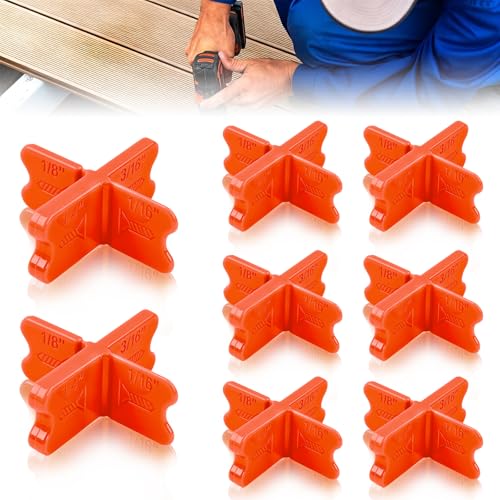
Universal Sizes: 1/16", 1/8", 3/16", and 1/4". These deck board spacers provide precise spacing control for your decking project, eliminating manual measurement errors and ensuring consistent spaces between boards

Universal Sizes: 1/16", 1/8", 3/16", and 1/4". These deck board spacers provide precise spacing control for your decking project, eliminating manual measurement errors and ensuring consistent spaces between boards
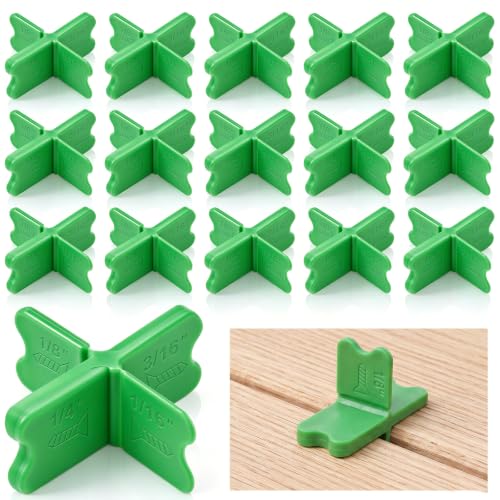
16 Piece Pack for Long Deck Runs: our ABS deck spacer tool set contains 16 Deck Spacers, a sufficient quantity to easily handle patio renovations or long distance board laying without frequent shim adjustments, improving work efficiency; Ideal for quick, consistent spacing installation of pressure treated lumber, composite decking, and PVC decks
Calculating the Right Number of Deck Boards for Your Project
Getting the board count right requires three fundamental calculations: determining your deck’s total square footage, figuring out how many boards fit across the width with proper spacing, and then accounting for waste and cuts.
Start by multiplying your deck’s length and width in feet to find total square footage. Convert your board measurements from inches to feet, then calculate each board’s coverage area. Divide total deck square footage by individual board coverage to estimate your needed quantity.
Next, factor in your deck layout’s complexity. Add 10-15% additional boards for waste, irregular cuts, and mistakes. This conservative approach prevents costly delays. When planning cuts around posts, use post-sized templates to ensure accurate measurements and minimize material waste. Your deck’s foundation should be built with pressure-treated lumber for the substructure to ensure durability and longevity.
Finally, verify your board measurements against actual spacing requirements. Divide your deck width by combined board width plus gap spacing to confirm accurate board placement across your deck layout.
How Joist Spacing Affects Board Layout and Spacing
Your deck’s joist spacing directly influences how many boards you’ll need and where they’ll land on your frame. Standard 16-inch on-center spacing works well for perpendicular layouts, but diagonal patterns require tighter 12-inch spacing to prevent excessive board span and sagging. Closer joist spacing improves joist alignment with board ends, ensuring consistent gaps and reducing installation difficulties. This tighter spacing also enhances deck stability by providing more fastening points and better edge support, minimizing board movement and flex. Irregular joist spacing creates uneven gaps and misalignment issues. For best results, match your board pattern to appropriate joist spacing—tighter spacing accommodates more layout flexibility and reduces the risk of unsupported board edges or overhang problems that compromise structural integrity. When selecting materials for your deck boards, consider options like wrought iron for high-traffic areas where exceptional durability and strength are priorities. Certain high-stress areas like stair stringers may need even closer spacing to safely support concentrated loads and maintain long-term durability.

Low Carbon Steel,Finish: Hot Dip Galvanized

Low carbon steel, Black Powder Coating Finish

Enhanced Joint Integrity: enhance the structural integrity of your projects with our galvanized framing angles; These angles not only reinforce joints for stronger, straighter corners but also adapt to various sizes and thicknesses, suitable for light-duty to medium-duty tasks from light-duty jobs to hefty structural tasks
Material-Specific Spacing Requirements and Considerations
Since different decking materials behave differently in response to moisture and temperature changes, you’ll need to adjust your board spacing based on what you’re installing. Kiln-dried wood requires 3/16 to 1/4-inch gaps since it’s already stable. Air-dried lumber demands tighter 3/32 to 1/8-inch spacing because wood moisture causes continued shrinkage after installation. Pressure-treated boards need minimal gaps initially—they’ll naturally develop approximately 1/4-inch spacing as they dry. Composite materials like Trex require 3/16-inch standard gaps, expanding to 3/8-inch in humid climates. Temperature matters too: install composites above 40°F with 1/8-inch end-to-end gaps, or below 40°F with 3/16-inch gaps. For composite decking with hidden fastener systems, proper spacing becomes even more critical since the fasteners are inserted into board grooves and must align precisely with joist centers. Materials like rubberwood are unsuitable for outdoor decking due to high moisture absorption and sensitivity to environmental conditions, making them prone to warping and deterioration. Avoiding spacing mistakes now prevents buckling, warping, and premature board failure later.

4 Precision Gap Sizes:Includes 2 spacers each of 1/16", 1/8", 3/16", and 1/4" thickness for consistent deck board spacing in all climate conditions.


Complete 4-Piece Spacer Set: This deck spacer tool set provides 4 reusable spacers - the ideal quantity for most decking projects. The practical number ensures you'll have the right spacer available, whether you're working on repairs or new installations
Professional Tips for Installing Boards With Perfect Spacing
How do you maintain consistent spacing across an entire deck installation? You’ll need reliable installation techniques and proper gap maintenance throughout your project.
Start by selecting the right tools for your situation. Decking spacers, 16D nails, or custom-cut lumber pieces help you achieve uniform gaps. For composite decking, self-gapping fastener clips eliminate guesswork. Hidden fastener systems like side-groove fasteners are specifically engineered to promote even board spacing while keeping your deck surface free of visible screws and nails.
Check board alignment every few rows to catch spacing issues early. Install boards with consistent pressure and verify they’re level and in plane with each other. Pin boards at the ends for minor adjustments.
Account for wood movement by adjusting gaps based on weather conditions—slightly larger gaps for wet boards, smaller for dry ones. After installation, recheck your work within a few days to confirm gaps remain consistent and boards haven’t shifted.
Consider integrating adjustable shading elements like retractable canopies or shade sails above your deck to protect your boards from excessive moisture and UV exposure, which can affect wood movement and gap consistency over time.