How to Cut Deck Boards Around Posts for a Perfect Fit
You’ll create a template using thin cardboard or plywood, then trace your post outline onto it for precision. Align the template with your deck’s diagonal angle and test-fit it on the actual post. Mark cut lines with a speed square, measure carefully from post to deck edge, and verify measurements before cutting. Use a jigsaw for tight spaces around posts, cutting slightly outside marked lines. Tight, seamless notches guarantee structural integrity and professional results—discover the specific techniques that’ll perfect your installation.
Creating a Template for Diagonal Decking
How do you guarantee a perfect fit when cutting deck boards around posts at diagonal angles? You’ll start by selecting thin, flexible template materials like cardboard or thin plywood that conform easily to your post’s outline. Trace the post shape directly onto your template for precision, then cut it carefully using a utility knife or jigsaw.
Next, align your template edge with the diagonal decking angle before tracing. Mark the angle clearly on the template to ascertain consistent positioning during installation. Account for board width and spacing when cutting, then test fit the template on the actual post. Make adjustments as needed for irregular post shapes, making sure your template captures every contour before transferring it to your deck boards. For best results, ensure the wood is clean and dry before cutting and installing your boards, and consider applying Restore Deck Coating after installation to protect your newly fitted boards from moisture and weathering.

PRECISE CURVE & PATTERN DUPLICATION: Our 107” Steel Curve Template Tool helps you to easily replicate and transfer complicated patterns or curves to your work piece, enhancing efficiency in woodworking, metalworking, and crafting projects.

PRECISE CURVE TRANSFERS: Effortlessly transfer intricate curves from patterns or workpieces to new projects, ensuring accuracy in every woodworking or DIY task.

STURDY FOR MAKING REUSABLE STENCILS : 7Mil (0.1778mm / .007") thick, 10 PCS, 12X12 inch/30.5X30.5cm, large and wide enough mylar sheet to provide excellent support for your complex design projects.
Measuring and Marking Techniques for Accuracy
Accurate measurements and clear markings form the foundation of perfectly fitted deck boards around posts. You’ll need to measure the distance from the post to the deck’s edge using a tape measure, accounting for 1–2 inch overhangs for clean trim cuts. Record these measurements on graph paper or a digital planner for reference.
Position each board against the post and mark your cut line with a pencil. Use a speed square to guarantee straight lines and mark both ends for consistency across multiple posts. Label boards with their intended locations to prevent confusion during installation. Proper board alignment during this marking phase will help ensure that hidden fasteners remain concealed once the boards are secured to the joists.
Before cutting, verify all measurements match your deck plan. Double-check marked lines for straightness and alignment. Ensure your deck framing is properly attached to the house with a ledger board installed according to building codes for structural integrity. These measuring techniques and marking accuracy practices eliminate material waste and guarantee professional results.
Aligning Boards With Posts for Proper Fit
When you’re ready to position your boards, you’ll want to start your layout from the rim joist toward the house, guaranteeing that full-width boards align directly with your posts. This approach prioritizes the most visible areas while providing maximum structural support.
Use deck spacers to maintain consistent spacing between boards, which guarantees proper fit and uniform appearance around post positioning. Install blocking where decking changes direction to create solid fastening points at post intersections.
Plan your board alignment strategically by spacing joints at least 4 feet apart. This prevents weak spots and maintains a straight, professional appearance. Ensure your ground clearance requirements are met to prevent moisture damage and warping beneath the deck structure. After installation, applying quality deck stain in thin, even coats will protect the wood and enhance its appearance over time. By following this systematic board alignment method, you’ll achieve both aesthetic appeal and structural integrity throughout your deck installation.
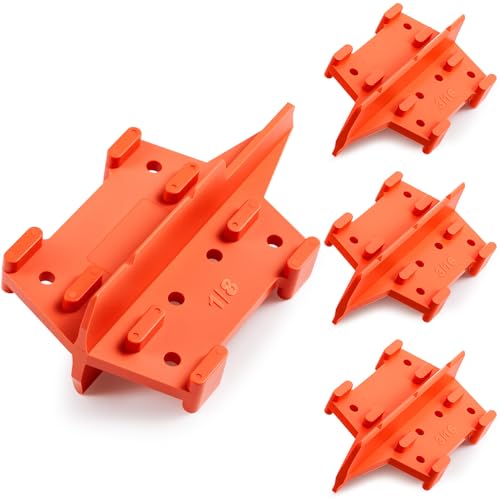
Functionality: the deck spacers feature either 1/8" or 3/16" shim edges; It spaces deck lumber apart to allow for adequate expansion and contraction to minimize guesswork; The efficient design of this decking tool ensure not only a visually appealing finish but also a solid foundation, elevating the quality and durability of your decking endeavors
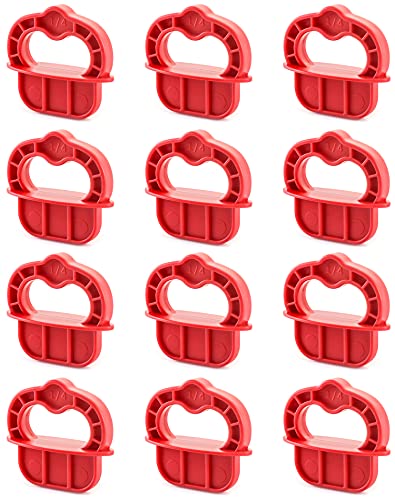
Secure and Durable: Made from quality plastic material, these spacer rings securely hold the deck boards in place, preventing movement and warping over time. 12 Pack.
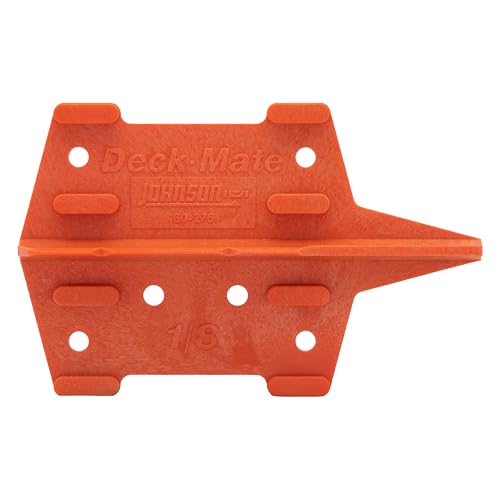
QUALITY CONSTRUCTION: The decking tool features a high-impact body that promises to withstand the test of time. The compact tool can survive the toughest outdoor situations for lasting performance
Essential Cutting Tools and Equipment Setup
You’ll need several essential power tools to cut deck boards accurately around posts and structural elements. A rear handle circular saw handles most board cuts efficiently, while a jigsaw enables precise cuts in tight spaces around railings and posts. For cutting efficiency, invest in quality blade selection—36-tooth carbide-tipped blades work well for composite materials, while specialized Diablo blades guarantee clean edges on PVC decking.
Set up a dedicated work station with a universal miter saw stand to organize your workspace and reduce material waste. Use decking adapter kits on quick-grip clamps to secure boards while maintaining proper spacing. Carbide-tipped blades prevent dulling when working with hardwoods. Power brakes on quality saws enable rapid wind-down after cuts. Maintain multiple blade types for consistent performance across varying materials throughout your installation. For fastening your cut boards securely to joists, #10 x 3 screws provide the ideal balance of strength and durability for most deck installations. When working around structural posts that support pergola beams, understanding maximum beam spans helps you plan cuts that won’t compromise the structural integrity of load-bearing elements.

3 Inch Saw Blade for Circular Saw 3-pack, 3/8" arbor(9.53mm), 0.063" Kerf(1.6mm), 36T(Tungsten Carbide Tipped), MAX RPM 19,500

Specifications: 3" 36T/80T 3PCS, 7/16 " arbor,3/8" bushing, Always confirm your saw’s arbor size before ordering, Avoid situations where the product cannot be used due to issues with the shaft diameter!
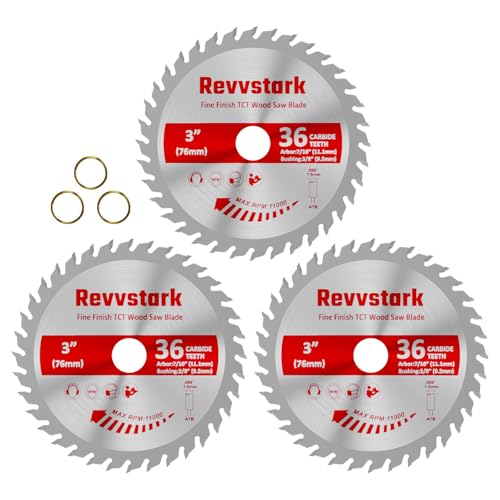
SPECIFICATION: Diameter: 3 inch circular saw blade(76 mm); Arbor size: 7/16 inch(11.1 mm) ; Bushing: 3/8"(9.5 mm); Max Rpm:11000; Carbide Teeth: 36 T
Preparing Your Jigsaw for Precise Cuts
Proper jigsaw setup separates clean, professional cuts from ragged edges and material waste. You’ll start by selecting the right blade types for your deck boards—use wood-cutting blades with low teeth per inch for faster cuts through thick decking, or high TPI blades for cleaner results on thinner materials. Next, secure your blade firmly in the clamp and inspect it for wear or damage. Align the blade precisely with your cut line before starting. Then configure your orbital action settings based on your material thickness and desired finish. Set orbital action to zero for maximum control on visible edges, or use higher settings (1–3) for aggressive cuts through dense decking. For complex cuts around posts, consider using bevel gauges to determine the correct angles needed for seamless joints. Like painting vinyl straps, jigsaw work requires thorough surface preparation to ensure optimal results. These preparations guarantee accurate, splinter-free cuts around posts every time.

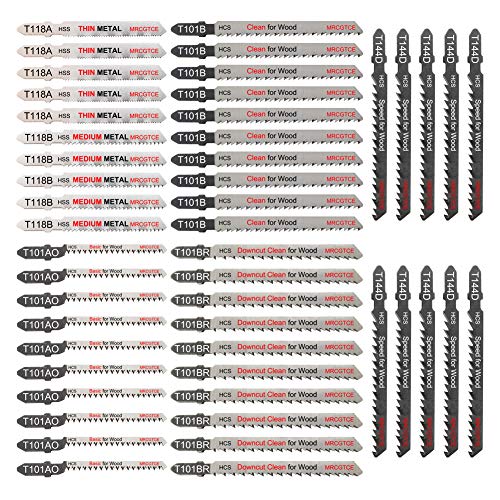
Boost Efficiency - Our blade's unique design, with teeth facing in opposite directions at each end, ensures ultra-fine finishes on both the top and bottom of the wood.

MULTIPLE BLADE TYPES: Designed for cutting laminate and wood, including high-performance blades for optimal results
Notching Techniques for Snug Post Fit
With your jigsaw calibrated and ready, you’re prepared to move beyond edge work and tackle the more demanding task of notching deck boards around posts. Begin by establishing precise notch dimensions—measure your post’s diameter or width carefully. Mark your cutting patterns on both sides of the board using a speed square for accuracy. For round posts, you’ll use curved cuts; for square posts, straight lines suffice. Cut slightly outside your marked lines to allow for chisel refinement. Remove waste material gradually to prevent splintering. Keep your blade depth just below the board thickness for safety. Test-fit frequently, adjusting as needed. After notching is complete, apply protective finishes such as oils or sealants to the newly exposed wood surfaces to enhance longevity and protect against weather damage. Ensure you use corrosion-resistant screws when fastening the notched boards to joists to prevent rust and maintain long-term structural integrity. This methodical approach guarantees tight, seamless notches that support your deck’s structural integrity.
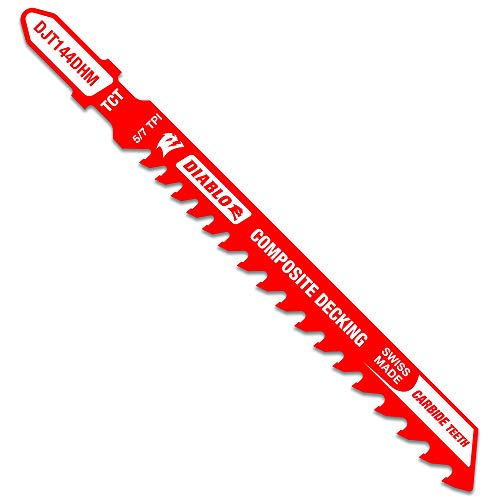
Extreme Durability - Provide up to 50X longer cutting life compared to standard blades, making them ideal for composite decking materials, wood, PVC, and other demanding applications.

Sold on Amazon

Optimized Blade Design - Reduces heat and pitch buildup. ensuring smooth, efficient cutting and extending blade life. This 4" blade allows cleaner cuts and preventing from overheating.
Using Brad Point Bits for Corner Marking
Brad point bits offer three distinct advantages that make them ideal for marking deck board corners: their central sharp point prevents bit wandering, their outer cutting spurs create clean circumferences before the main edge cuts, and their spiral flutes efficiently evacuate chips. You’ll achieve superior hole placement accuracy on both softwood and hardwood, with minimal exit tear-out.
Your drill technique matters greatly. Mark corner locations with a fine-tip marker, position the bit directly on target, and apply steady, moderate pressure while starting slowly. This prevents deflection and guarantees concentricity. Use a backup block when drilling through thin boards to minimize tear-out. For outdoor deck applications, consider applying UV protection finishes after drilling to prevent weathering and extend the life of your deck boards. Proper hole spacing during installation also contributes to overall deck stability, similar to how joist spacing affects the structural integrity of your deck frame.
Material compatibility is excellent for standard deck boards, though composite materials may challenge the bit. Keep your bits sharp—dull bits compromise precision and increase surface roughness. Clean flutes regularly for maximum chip removal efficiency.
Rounding Over Cut Edges for Water Shedding
Once you’ve drilled your corner holes and made your cuts around the posts, you’ll need to address the sharp edges left behind. Rounding over cut edges prevents water pooling at corners and considerably improves your deck’s durability.
Use a handheld router with a roundover bit for precise, consistent results. An angle grinder with a sanding disc offers quicker shaping for larger areas. Apply a 1/8″ to 1/4″ edge radius on standard boards, increasing to 3/8″ for high-traffic zones or wider boards.
After rounding, sand the edge smooth to remove tool marks. Apply water-resistant sealant to protect the rounded surface and seal the end grain, which is especially vulnerable to rot. For long-lasting protection, ensure proper adhesion of the new coat by preparing surfaces thoroughly before applying any sealant. Inspect periodically and reapply sealant as needed to maintain water-shedding properties.
Finishing and Staining Your Cut Edges
After you’ve rounded and sanded your cut edges, you’ll need to protect them from moisture infiltration with proper sealing and finishing techniques. You’ll apply a waxy end-cut treatment using just a paint brush, which effectively prevents checking and wood degradation. Select a paint color matching your deck boards for seamless appearance. Your sealing methods can include immediate application after cutting or waiting through a weathering period—both approaches work effectively. Before applying any finish, ensure you’ve completed thorough cleaning with appropriate cleaners to remove all dust and debris from the cut surfaces. For enhanced protection and longevity, consider applying transparent or semi-transparent stains with UV filters to your cut edges to control mold and mildew growth. For enhanced aesthetics, consider installing fascia boards or bullnose decking over cut edges, which provides superior protection while creating a polished perimeter. These finishing techniques reduce long-term maintenance demands and greatly extend your board lifespan. Proper edge sealing transforms rough cuts into durable, attractive deck components that withstand moisture exposure and seasonal weather changes.
Common Mistakes to Avoid and Pro Tips
While proper finishing protects your cut edges, preventing mistakes during the cutting process itself saves you from costly rework and structural problems. You’ll avoid gaps by accounting for required bearing surfaces—composite decking materials need 1.5 inches of support at each end. Measure accurately from your previous board to prevent misalignment. Always allow expansion gaps between boards to prevent buckling.
Critically, don’t cut posts unless absolutely necessary; doing so compromises structural integrity. Instead, cut boards to fit around them. Use a sharp circular saw or jigsaw, cutting slowly for precision near post intersections. Slide boards against previous ones to trace exact intersection points. Mark cut lines with a pencil held at 45 degrees for accuracy. Double-check fit before finalizing cuts—minor adjustments beat starting over. When working with composite decks, remember to remove plugs covering screws before accessing fasteners underneath to ensure a clean installation around posts. For natural wood decking materials like cypress and cedar, their natural resistance to decay and moisture makes them forgiving choices when precision cuts are challenging.