Proper Joist Spacing for 5/4 Deck Boards: A Guide
You’ll space your 5/4 deck joists at 16 inches on center for standard installations, which provides maximum load capacity and structural support. If you’re installing diagonal decking, tighten spacing to 12 inches on center because the shifted stress distribution requires additional support. Composite materials also demand 12-inch spacing due to deflection concerns. Always verify your local building codes and manufacturer specifications before finalizing your design, as requirements vary by jurisdiction and material type. Understanding these spacing fundamentals guarantees you’ll build a safe, compliant deck—and there’s much more to contemplate for a professional-grade installation.
Understanding Standard Joist Spacing Requirements
When you’re planning a deck, you’ll need to determine the proper joist spacing, which forms the structural foundation for your decking boards. The industry standard calls for 16 inches on center—the distance measured from the center of one joist to the center of the next. This spacing works well for most residential applications and offers good deck material compatibility with traditional wood decking.
However, you shouldn’t overlook load capacity considerations. Your specific joist spacing depends on several factors: joist size, span length, and the weight your deck must support. Larger joists accommodate wider spacing, while longer spans require closer spacing to maintain stability. Ground-level decks with pressure-treated wood can sometimes handle 24-inch spacing, though closer intervals enhance durability. For decks with diagonal board installation or angled patterns, tighter spacing is recommended to prevent excessive deflection. The most common residential joist sizes—2×6, 2×8, 2×10, and 2×12—are selected based on your specific span and load requirements. Always verify local building codes before finalizing your design.

💧 UNDER DECK DRAINAGE MEMBRANE: Built from 0.5 mm HDPE, this flexible under deck drainage membrane fits between deck joists to form a continuous channel for collecting and directing rainwater.ystem: Designed to help collect and channel rainwater between deck joists, creating a cleaner and more usable space below your deck.

Deck drainage system: Recommend Installing Muzata deck water drain membrane M081 with gutter downspout M078 to funnel rain and liquid into the gutter. By effectively managing water, helps in maintaining the structural and aesthetic quality of your deck for years to come

Effective protection: This downspout suits deck systems with 12 "or 16" joist spacing. Water from the deck is diverted by an under-deck drainage system, preventing the deck timbers from being affected by moisture
Adjusting Spacing for Angled Deck Installations
Because diagonal decking patterns create larger bays between joists when measured perpendicular to the board run, you’ll need to tighten your joist spacing from the standard 16 inches on center to 12 inches on center. This angled board adjustment accommodates diagonal load considerations that differ fundamentally from perpendicular installations.
When you install 5/4-inch composite boards at 45-degree angles, the stress distribution shifts across a wider area, demanding closer support. At 16-inch spacing, diagonal layouts produce approximately 20-inch bays—too wide for adequate support. Reducing to 12-inch spacing generates 15- to 17-inch bays, providing the structural rigidity your diagonal deck requires.
You must verify your specific composite manufacturer’s requirements before construction, as installation manuals detail exact spacing specifications for angled applications. Proper stain adhesion and durability depend on having a well-prepared substrate, which reinforces why structural integrity through correct joist spacing is equally critical. Consult local building codes, which typically mandate 12 inches on center as minimum spacing for diagonal decking.
Proper Deck Board Spacing Between Planks
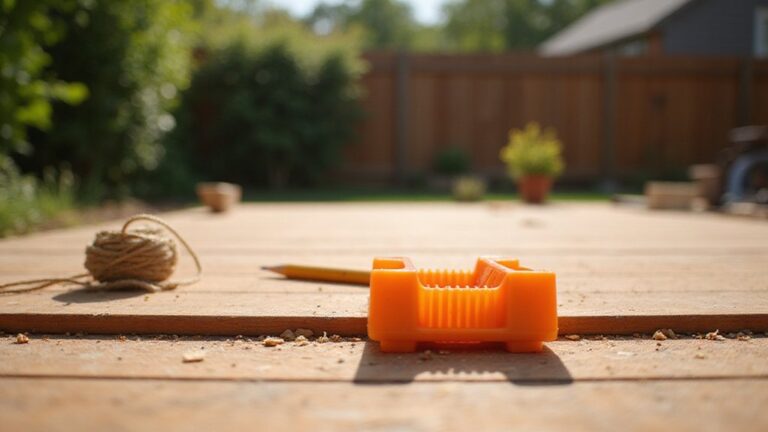
After you’ve secured your joists at the proper spacing, controlling the gaps between individual deck boards becomes your next critical consideration. You’ll want to maintain consistent 1/4″ spacing between planks for fully seasoned 5/4 boards, though installation gaps of 1/4″ to 3/8″ accommodate water drainage and debris removal during deck maintenance.
Use sixteen-penny nails as reliable spacing tools to maintain uniform gaps throughout installation. This simple method guarantees a professional appearance while preventing heel entrapment hazards. Avoid gaps exceeding 3/8″ inch, which create structural concerns and aesthetic problems.
Your initial tight installation naturally expands to proper spacing as pressure-treated lumber shrinks seasonally. This approach eliminates manual spacing calculations while assuring adequate ventilation and drainage beneath your deck surface. Pressure-treated boards that are wet and saturated when new should be installed tightly together, and proper framing for drainage ensures moisture can escape as the wood dries and acclimates. For composite decking materials, maintain slightly larger gaps of 1/8″ to 1/4″ to accommodate their different expansion and contraction characteristics compared to wood.

Secure and Durable: Made from quality plastic material, these spacer rings securely hold the deck boards in place, preventing movement and warping over time. 12 Pack.

Kit includes (175) Black Hidden Deck Fastener Ipe Deck Clips, (175) #8x2” black T15 stainless steel screws, driver and drill bits plus gap spacer tools

【1/4'' Deck Spacer & 20-Pack】This listing: Green, 1/4-inch deck spacers. Quantity: 20-pack per box. Ideal for long spans decking.▼Color & Size Options: Red: 1/8" (3.2mm) spacing, Orange: 5/32" (4mm), Yellow: 13/64" (5.2mm), Green: 1/4" (6.4mm), Blue: 5/16" (8mm) or MIX Pack (4 pcs of each size).
Installing Blocking Between Joists
Once you’ve established consistent spacing between your deck boards, you’ll need to address joist stability through proper blocking installation. Blocking techniques involve cutting lumber matching your joist dimensions and fastening pieces perpendicular between joists at 4 to 6-foot intervals. Install blocking flush with joist tops to maintain level decking surfaces, using exterior-grade screws or nails through joist sides for secure attachment.
The structural benefits are significant. Blocking prevents joist twisting and rotation, provides lateral stability across long spans, and distributes loads evenly. It also minimizes bounce and deck movement while reducing extension stresses on individual joists. For optimal results, ensure your joists are properly spaced at 16″ or 24″ centers depending on your board thickness. For decks exceeding 8 feet, mid-span blocking becomes mandatory per code. Alternating blocking placement on opposite joist sides facilitates fastening while reducing visual impact on your finished deck. Proper blocking installation works in conjunction with correct joist spacing requirements to ensure your deck maintains structural integrity over time.

Self-Drilling Point: Together, coarse screw threads and a self-drilling point design eliminate the need for a pilot hole

Superior Corrosion Resistance: Ruspert coating, ideal for pressure-treated lumber, matches hot-dip galvanization (ASTM A153, Class D) for excellent rust protection in outdoor conditions.

Superior Corrosion Resistance: Ruspert coating, ideal for pressure-treated lumber, matches hot-dip galvanization (ASTM A153, Class D) for excellent rust protection in outdoor conditions.
Selecting and Installing Fasteners Correctly
The fasteners you select will directly determine your deck’s longevity and structural integrity. You’ll want stainless steel deck screws—Type 304 or 316—for superior corrosion resistance, particularly in coastal areas. For salt-water proximity within 20 miles, Type 316 becomes essential.
Choose 2.5 to 3-inch screws for standard 5/4 decking, guaranteeing minimum 1-inch joist penetration. Space fasteners 24 inches apart along joists for ideal holding power.
Match your fastener types to wood species: coarse-threaded screws grip softwoods effectively, while fine-threaded options work better in hardwoods. Use self-drilling stainless steel screws to eliminate pre-drilling requirements. For cedar specifically, pre-drilling is essential to avoid splitting the dense wood.
Critically, confirm all fasteners and connectors share identical metallic composition. This prevents galvanic corrosion that compromises your deck’s structural reliability over time. For composite and hardwood decking installations, consider supplementing traditional fasteners with hidden fastener clips to achieve a cleaner appearance while maintaining structural security.

30% FASTER INSTALLATION TIME vs. COMPETITION: Complete your project faster

Premium 304 Stainless Steel: Our deck screws are crafted from high-grade 304 stainless steel, renowned for its rust resistance and durability. This material choice ensures long-term performance even in the most challenging outdoor conditions, including coastal environments where salt air is prevalent. Whether you’re working on residential or commercial projects, these screws are engineered to withstand the elements without corrosion.
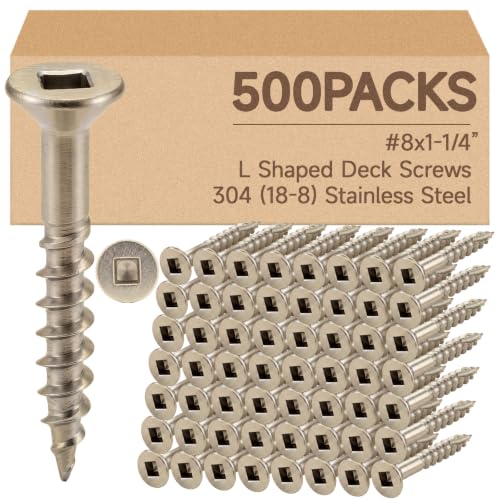
Stainless Steel: made from 304 18 8 stainless steel screws, these stainless steel deck screws provide strong corrosion resistance and rust protection; Ideal for outdoor, marine, and humid environments, ensuring sturdy performance without staining or weakening
Measuring and Verifying Your Framing Configuration
Installing your fasteners correctly sets the foundation for a reliable deck, but that reliability depends equally on confirming that your framing itself is properly configured. You’ll need proper measurement tools—a tape measure, carpenter’s level, and long straightedge—to validate joist spacing and alignment. Measure from center to center between joists, typically 16 inches on center for 5/4 boards. Use chalk lines as framing techniques to mark joist locations from a fixed reference point. Check that all joists are level and crowned upward, then inspect for uniform sizing and structural soundness. Ascertain blocking placement maintains spacing integrity. For diagonal deck installations, consider that closer joist spacing may be required to ensure adequate support and reduce board deflection. Proper joist spacing also provides superior protection against moisture and structural damage that can compromise your deck’s longevity. Double-check your measurements before fastening joists to catch errors early and secure your deck’s structural integrity.
Ensuring Manufacturer Compliance and Code Standards
While you’ve confirmed your framing measurements and verified joist alignment, you’ll now need to ascertain that your spacing configuration complies with both manufacturer specifications and local building codes. You’ll find that standard wood decking permits 16 inches on-center spacing, while composite deck materials require tighter 12-inch spacing due to deflection concerns. Consult your manufacturer’s documentation and local building department guidelines, as spacing regulations vary by jurisdiction and material type. You should verify that your joist size and wood species align with IRC span tables governing maximum allowable spans. Document your spacing measurements using the on-center method before installing boards. Additionally, ensure your railing posts maintain proper post spacing to support the structural integrity of your deck system. Professional deck installation requires attention to labor costs and regional factors that may influence your contractor selection and project timeline. This verification prevents costly code violations and assures your deck meets structural safety requirements, protecting both your investment and user safety long-term.