Can You Cut Decking Boards With a Jigsaw? Expert Guide
Yes, you can definitely cut decking boards with a jigsaw—it’s ideal for precise curved cuts, notches around posts, and detailed patterns. You’ll want carbide-tipped blades with lower TPI configurations for composite materials and clean edges. Secure your boards with clamps, match blade speed to thickness, and maintain light pressure to prevent binding. Position the shoe flat and start the jigsaw before contacting material for smooth entry. Uncover specific techniques that’ll transform your deck installation projects.
Jigsaws for Decking Board Cuts: Why They Work
Control and precision—these are the hallmarks of jigsaw work on decking boards, and they’re exactly why this tool excels where others fall short. You’ll appreciate the jigsaw’s ability to handle detailed and curved cuts that circular saws simply can’t manage. The slower blade advancement speeds give you command over your cuts, reducing binding and kickback risks considerably.
What really sets jigsaws apart are their jigsaw features that enable internal cuts. You can drill a hole and insert the blade to create notches or patterns within boards—something other saws can’t do. Your control advantages extend to adjustable orbital action settings, which let you fine-tune cutting efficiency for composite materials without sacrificing accuracy. This versatility makes jigsaws indispensable for intricate decking work. For structural elements like deck framing joists, you’ll want to rely on different tools, as jigsaws are best reserved for the surface decking boards where precision and detailed cuts matter most.
After completing your cuts with precision, remember that thorough cleaning of the newly cut surfaces will prepare them for finishing and help ensure proper stain adhesion if you plan to finish your deck.
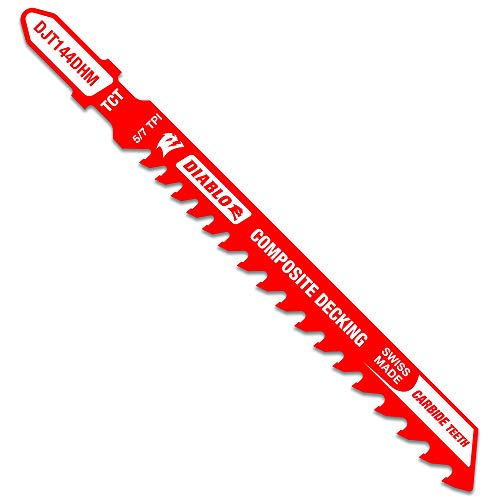
Extreme Durability - Provide up to 50X longer cutting life compared to standard blades, making them ideal for composite decking materials, wood, PVC, and other demanding applications.

Jigsaw blade model: T313AW. Provides sharp, smooth, and labor-saving cutting.(Compatible with the Following: T-Shank Jig Saws)
Selecting the Right Blade for Composite Materials
Now that you’ve got your jigsaw ready to handle those intricate cuts, selecting the right blade becomes your next priority—and it’s where many DIYers stumble. You’ll want carbide-tipped blades specifically engineered for composite materials—they stay sharper longer and prevent melting or gumming during cutting. Look for lower TPI configurations around 5/7, which enable faster cutting speeds without overheating your deck boards.
Consider T-shank compatibility options, as this standardized design works across 90% of current jigsaw models. T-shank blades guarantee consistent performance and allow easy swaps between tasks. For thick decking, Bosch T101 D blades or Diablo’s 4-inch, 5/7 TPI options deliver extreme durability and superior cutting life. These blade features combine aggressive capability with precision, giving you clean edges without material degradation. Proper blade selection also contributes to the lasting beauty and protection of your deck by ensuring clean cuts that maintain the integrity of your boards during restoration projects, while protecting against weather elements through sealed, clean edges.

Designed for cutting Plexiglas 5/64 In. to 3/4 In. thick
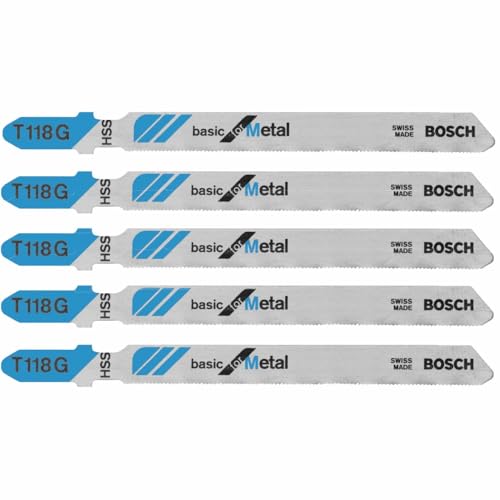
FOR SHEET METAL 17-26 GAUGE, VERY THIN METALS 1/64 IN. TO 3/64 IN. THICK (FERROUS AND NON-FERROUS)

POINTED TEETH REDUCE SPLINTERING ON BOTH SIDES OF THE WORKPIECE
Mastering Cuts Around Posts and Obstacles
Once you’re comfortable with basic jigsaw techniques, maneuvering around deck posts and railings demands a more strategic approach—one that combines proper stabilization, deliberate marking, and refined blade control.
Start by clamping boards firmly to prevent vibration and bounce during complex cuts. Next, enhance visibility enhancement by marking cut lines sharply with pencil or applying masking tape to dark surfaces. This keeps you aware of blade position throughout intricate maneuvers. For deck projects using hidden fastening systems, ensure your cuts accommodate CAMO edge fastening requirements to maintain the clean, fastener-free appearance.
Template creation saves time and guarantees consistency when cutting around multiple similar obstacles. Pre-made templates eliminate measurement errors and reduce material waste across repeated cuts.
Execute plunge cuts slowly at mid-board obstacles, starting slightly inside marked lines to prevent overcutting. Allow your blade to work without forcing it through tight corners. Gentle pressure and small backward resets maintain control near difficult angles, preventing blade binding and heat accumulation in composite materials. For balconies and outdoor decks, consider using UV-resistant composite materials that provide superior durability against environmental exposure.

Optimized Blade Design - Reduces heat and pitch buildup. ensuring smooth, efficient cutting and extending blade life. This 4" blade allows cleaner cuts and preventing from overheating.

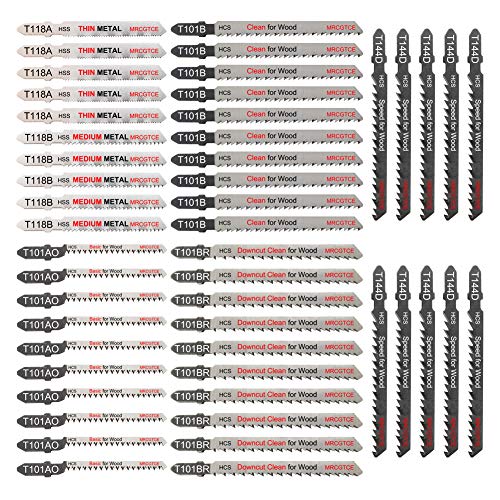
Cost-Effective Value - This 20-piece set offers up to 48% savings compared to buying individual blades, making it a smart choice for budget-conscious users.
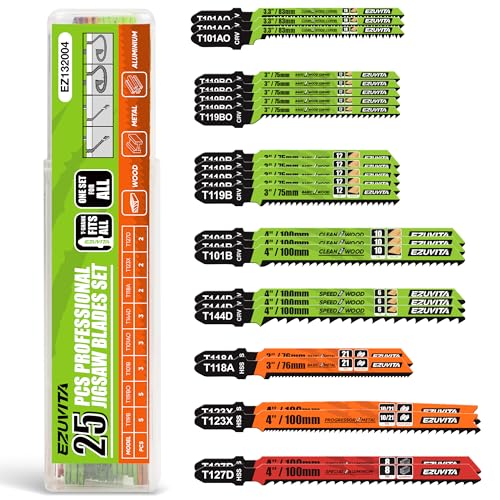
【One Set For All】The 25-Piece jig saw blades kit contains a variety of speed, smooth blades comprising a handy set for common wood projects, plastic and metal curve&straight cutting
Optimizing Speed and Positioning Techniques
Achieving clean, efficient cuts on decking boards requires you to dial in your jigsaw’s speed and positioning before making your first pass. Match your blade speed to decking thickness—use lower speeds (500–1000 SPM) for thick composite boards to prevent overheating, and higher speeds (1000–3000 SPM) for thinner wood. Position your jigsaw shoe flat against the workpiece for stability, and cut from the underside to achieve a clean top edge. Maintain consistent pressure along your cut direction to prevent blade deflection. Support both sides of the cut with clamps or sawhorses to minimize vibration. Start the jigsaw before contacting material, then ease into your cut smoothly. Let the blade do the work rather than forcing it through. Before beginning your deck project, verify that you have obtained the necessary zoning permit for your installation. Proper moisture drainage and airflow during the deck construction process helps ensure your decking materials acclimate correctly and perform optimally after installation.
Curved Cuts and Advanced Safety Practices
While maintaining the speed and positioning fundamentals you’ve established, you’ll reveal that curved cuts and tight angles demand different strategies and heightened attention to safety. For curved cuts, select narrow scrolling blades that navigate tight turns without binding. Position your cut slightly outside the marked line to prevent undercutting. Clamp boards securely to eliminate vibration and bouncing during operation. Drill pilot holes at corners before inserting your blade—this prevents blade walking and guarantees precise alignment. Apply zero clearance plates or painter’s tape to your jigsaw base, reducing splintering on fragile composite materials. Use moderate speeds to prevent overheating and melting. Template-based cutting—where you refine one piece, then use it as a guide for remaining boards—maximizes consistency and safety throughout your project. Just as thorough preparation is essential when applying finishes like stain, careful board preparation before cutting ensures optimal results and cleaner edges. Maintaining proper board spacing during the cutting process ensures that your cut pieces will fit correctly within your deck’s overall layout and allow for necessary expansion and air circulation.