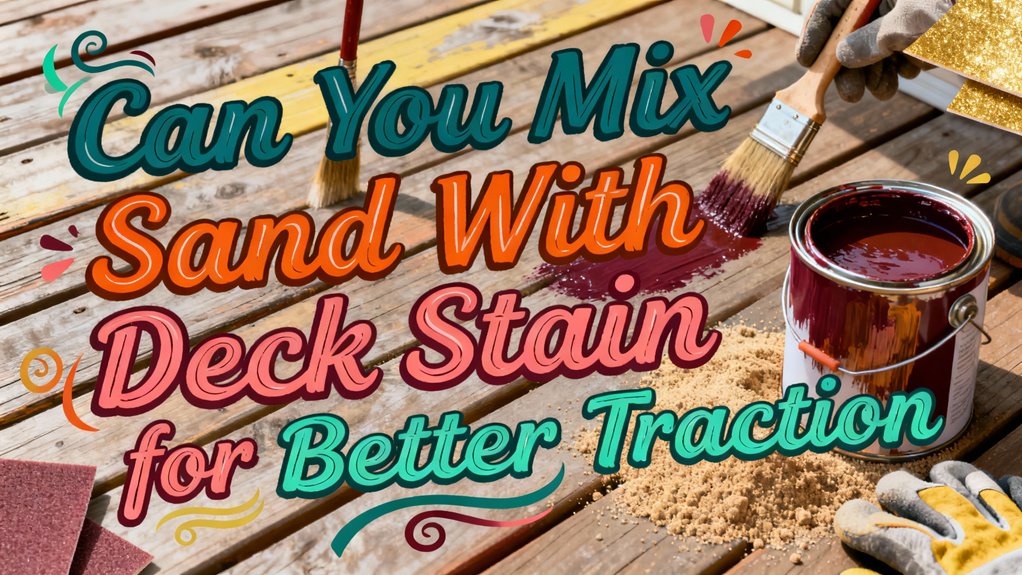
Can You Mix Sand With Deck Stain for Better Traction?
You can mix sand with deck stain to enhance traction on wet surfaces, but proceed cautiously. Coarse play sand or concrete sand works best—fine sand won’t provide adequate grip. Pre-mix sand with stain to prevent clumping, then apply during the tacky phase of your first coat. However, you’ll face potential bonding failures, uneven coverage, cleaning difficulties, and possible warranty voidance. Proper surface preparation and careful mixing ratios are critical. Understanding the specific challenges involved will help you achieve ideal results.
Why Add Sand to Deck Stain
When you’re looking to enhance your deck’s performance and safety, mixing sand into your stain offers substantial practical benefits that standard applications can’t match. Sand particles create texture variations that dramatically improve traction on wet or algae-covered surfaces, providing grip comparable to specialized anti-slip coatings.
You’ll gain significant safety enhancements, especially for children and elderly individuals prone to slipping. The sand-reinforced finish resists peeling and flaking better than stain alone, extending your deck’s lifespan by 20-40%. You’ll also reduce maintenance frequency and associated costs. Applying thin, even coats along the wood grain with proper application techniques helps ensure the sand particles remain evenly distributed throughout the stain layer.
However, exercise caution when selecting sand grades—too coarse creates discomfort underfoot, while too fine diminishes anti-slip effectiveness. Make certain proper mixing ratios to maintain stain’s protective properties without compromising adhesion or appearance. Similar to how hidden fastener systems require precise placement and alignment to ensure proper performance and longevity, sand-stain mixtures demand careful attention to composition and application technique.

REMOVES TOUGH STAINS: Quickly eliminates stains caused by food, drink, grease, cooking oil and more MULTI-SURFACE CLEANER: Ideal for composite decks, concrete, stone patios,...
Selecting the Right Type of Sand
Because not all sand is created equal, you’ll need to be deliberate about your selection to avoid compromising your deck stain’s effectiveness. Sand purity matters critically—beach sand and backyard soil introduce contaminants that create clumpy mixtures and residue affecting your final coating. Instead, choose play sand or concrete sand, both offering the cleanliness your project demands.
Particle size directly impacts traction performance. Coarser sand creates superior slip-resistant surfaces by generating more surface friction for foot traffic safety. Fine sand fails to deliver adequate traction and diminishes the protective benefits of your non-slip treatment. Apply sand exclusively to your first coat, allowing full drying time—typically 24 hours—before applying a sand-free topcoat that minimizes visible dark specks. To ensure proper adhesion and protection of your deck coating, avoid rain for at least 24-48 hours after application. Following manufacturer-specific guidelines ensures your sand-stain mixture performs optimally and maintains the durability of your deck coating.

This 50 Pound bag of sand is original Quikrete branded sand. This item is not sold by an authorized dealer or distributor.

Premium-Grade Play Sand – Soft and easy to mold wet this kid’s play sand has been carefully grated, washed, and dried to ensure it’s 100% safe, non-toxic, and great for early learning during indoor and outdoor play sessions.

OPAQUE FINISH W/ UV PROTECTION: #1 Deck Premium wood stains provide full coverage with an opaque finish, completely hiding the natural wood grain while protecting against fading, graying, peeling, and mildew from UV exposure
How to Mix Sand With Deck Stain
Now that you’ve selected the right sand for your project, you’ll need to understand how to properly incorporate it into your deck stain—and the truth is, not all stain types accept sand equally well. Pre-mix fine sand with a small amount of stain before adding it to your full container; this prevents clumping and guarantees even distribution. Stir both components separately first to avoid settling. Use a brush or roller rather than a sprayer, since sand clogs applicators easily. Work in small sections, maintaining consistent pressure for uniform application. Remember that mixing techniques directly impact the adhesive properties of your stain—thorough stirring before each application maintains sand suspension throughout the coating, preventing separation that compromises both traction and finish quality.

【Upgraded Material】Crafted with premium chenille for a plush, skin-friendly feel, this indoor outdoor rug features a breathable quick-dry middle layer and an anti-slip backing for safety on wood, tile, or concrete. UV-resistant inks keep colors vibrant, resisting fading from sun exposure

Made in Switzerland

INDOOR/OUTDOOR: Perfect for use in the backyard, patio, porch, balcony, deck, sunroom or any high traffic area indoors including the laundry room or mudroom. To clean your area rug, simply wash off with a garden hose! Quick-drying material.
Step-by-Step Application Process
Before you apply your sand-infused stain, you’ll need to meticulously prepare your deck’s surface—this step directly determines whether your finish will be professional-grade or prone to failure. Begin by thoroughly cleaning with wood-specific cleaners and pressure washing at 6-12 inches distance. Allow 48-72 hours for complete drying.
Sand progressively using 80-grit sandpaper first, then 120-grit for a smooth finish. Follow wood grain direction to avoid scratches. Perform a water beading test during your surface inspection to confirm adequate preparation.
Remove all dust with lint-free cloths or vacuuming before application. Your application techniques should involve natural-bristle brushes working the sand-stain mixture into wood fibers, starting from the deck’s far end. Maintain a wet edge and follow grain direction throughout to achieve consistent, professional results.

REMOVES TOUGH STAINS: Quickly eliminates stains caused by food, drink, grease, cooking oil and more

SEMI TRANSPARENT EXTERIOR WOOD STAIN: Our outdoor wood stain and sealer allows the natural wood grain to show through, highlighting the beauty of your decks, fences and sidings and preserving its natural look.
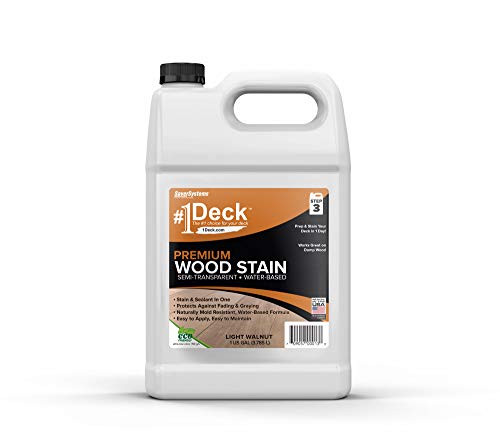
SEMI-TRANSPARENT WOOD STAIN: Enhance your deck or fence with a semi-transparent finish that lets natural wood grain show through. Perfect for decks, fences, and siding to preserve beauty.
Advantages of Using Sand-Enhanced Stain
When you blend sand into your deck stain, you’re fundamentally altering the surface’s slip-resistance properties—a critical consideration for safety in wet conditions. The traction benefits are immediately apparent: sand particles create a textured finish that increases friction underfoot, reducing slip incidents on moisture-laden surfaces.
However, surface safety improvements require careful evaluation. You’ll need to verify that your stain formulation can adequately suspend sand particles without settling or separation. Uneven distribution compromises effectiveness and creates hazardous bare spots. Additionally, consider maintenance implications—textured surfaces trap debris and complicate cleaning procedures. Proper drying time between coats is essential when working with sand-enhanced mixtures to ensure the particles remain evenly distributed throughout the application.
Before committing to this approach, consult manufacturer guidelines. Many commercial deck stains aren’t engineered for sand incorporation, potentially affecting durability, adhesion, and warranty coverage. Explore purpose-built anti-slip coatings instead, which are specifically formulated for peak performance and longevity.
Challenges and Limitations to Consider
Despite sand’s theoretical appeal for enhancing slip resistance, incorporating it into deck stain introduces a cascade of structural and practical problems that undermine the finish’s integrity. You’ll face premature failure as sand particles prevent proper bonding, allowing moisture to penetrate beneath the surface. Uneven distribution creates inconsistent traction while sand settles unevenly in your can, producing gritty patches that look patchy and feel uncomfortable underfoot. Cleaning challenges intensify because embedded particles trap dirt and complicate maintenance—pressure washing actually dislodges sand, reducing traction over time. Aesthetic concerns emerge as the stain appears mottled rather than uniform, which contradicts the goal of achieving a smooth finish through proper staining techniques. Most critically, you’re introducing safety hazards; loose particles become slipping risks while the accelerated wear creates dangerous uneven surfaces. Manufacturers void warranties when you add sand, leaving you unprotected against premature degradation. For more effective traction solutions on outdoor surfaces, consider alternative approaches like securing strong fasteners and proper tensioning hardware that maintain both durability and safety without compromising the integrity of your finish.
Expert Tips for Best Results
If you’re committed to adding sand to your deck stain despite the inherent risks, you’ll need to follow precise protocols to minimize failure. Your mixing techniques directly determine traction improvement outcomes. Thoroughly blend sand or anti-slip granules into stain before application—inadequate mixing produces blotchy coverage and inconsistent grip. Use rolling applicators rather than brushes for large areas, as they distribute sand-stain mixtures more uniformly. Apply two thin coats with 20 to 30-minute intervals, distributing sand during the tacky phase of your first coat. This strategic timing maximizes adhesion and prevents lap marks. Light sanding with 60–80 grit sandpaper before application creates a uniform foundation, while proper surface cleaning removes debris that compromises sand-stain bonding. Ensure 24 to 48 hours of drying time after your initial cleaning to provide the optimal foundation for sand-stain adhesion. Keep in mind that stain types vary widely in price and composition, which can affect how well sand adheres to your deck surface and the final appearance of your traction solution.

【STAIN & SEAL】- DWIL outdoor wood stain combines staining and sealing in one simple step, helping reduce the need for separate primers or topcoats on many wood projects. It adds a warm peach wood color while enhancing the natural wood grain, making it a practical choice for larger DIY deck, fence, and outdoor furniture refreshes.
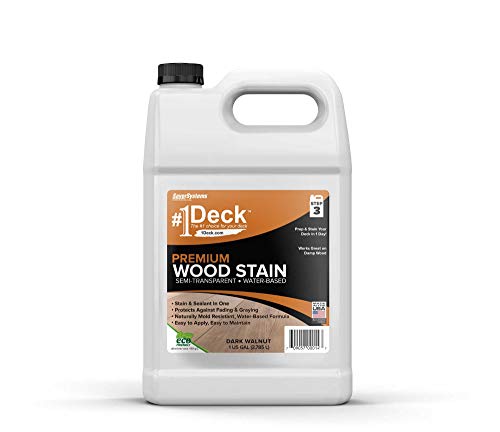
SEMI TRANSPARENT EXTERIOR WOOD STAIN: Our outdoor wood stain and sealer allows the natural wood grain to show through, highlighting the beauty of your decks, fences and sidings and preserving its natural look.

NON-SKID DECK PAINT: Durable, textured, low-glare high-traction surface for secure footing, with a comfortable rubberized texture that's less abrasive than traditional silica additives