How to Install Deck Boards Without Visible Fasteners
You’ll install hidden fastener systems by using specialized clips or screws that conceal beneath your board surface. Start from the deck’s outer edge, maintaining consistent 1/8-inch gaps between boards. Center fasteners on joists and drive screws at 45-degree angles for best grip. Use exterior-grade stainless steel hardware to prevent corrosion. Press clips downward fully to engage teeth into grooves. This technique eliminates visible fasteners while maintaining structural integrity. The details behind each step will elevate your deck’s professional finish.
Essential Tools and Materials for Hidden Fastener Installation
Before you begin installing deck boards with hidden fasteners, you’ll need to gather the right combination of specialized tools and materials.
Your fastener selection depends on your decking type and chosen system. You’ll need exterior-grade stainless steel screws, typically in T10 star drive or TORX configurations. Invest in a cordless drill/driver and a specialized installation tool like the Trex Hideaway One-Step Tool or CAMO Marksman Pro. If your boards aren’t pre-grooved, you’ll need a groove-cutting router bit. Hidden fastener systems like TigerClaw TC-G Clips are specifically designed for grooved decking boards and create secure attachments that remain invisible.
Stock construction adhesive in a caulk gun for hardwood applications. Gather material-matched deck plugs if using a Cortex system with collated strips.
For optimal deck performance, ensure your joist spacing does not exceed 16 inches on center, as this affects the fastener placement intervals throughout your installation. For tool maintenance, keep replacement screws and bits on hand to make certain your equipment stays functional throughout installation. Proper fastener selection and regular tool maintenance guarantee professional results.
Preparing and Installing Your First Board
Now that you’ve assembled your tools and fasteners, you’re ready to begin the installation process—and success starts with properly positioning your first board. Start from the deck’s outer edge rather than the house for better control. Use chalk lines to guarantee your first board alignment remains perfectly parallel to the frame. Install a starter board against the house, maintaining a 1/8-inch to 3/16-inch gap for expansion.
Measure your deck width at multiple points to verify even placement. Select a straight board without warping, checking it before installation. Snap reference lines along the joists as positioning guides.
For spacing considerations, maintain consistent gaps between boards using deck spacers. Plan staggered joints at least 4 feet apart. Use hidden fasteners designed for your decking material, securing them in pre-cut grooves to ensure a seamless appearance without visible screws. After installation is complete, consider applying a clear sealer to protect your deck from moisture and UV damage while maintaining the natural wood appearance. Check alignment frequently and adjust with a pry bar if needed.
Mastering Hidden Fastener Placement Techniques
Hidden fastener placement is where precision determines whether your deck will remain secure and visually flawless for years. You’ll achieve best fastener alignment by centering screws on joists and driving them at 45-degree angles for superior grip. For angled installations, offset fasteners approximately half an inch toward the joist’s long point to prevent screw exit.
Before driving screws, press clips downward fully to engage teeth into the deck board groove. This guarantees firm holding and proper hidden installation. Mark screw locations in advance to maintain consistent placement across all boards. Maintaining stainless steel fasteners throughout your installation prevents corrosion and ensures long-term durability of your hidden fastening system.
Avoid over-driving screws or hammering boards directly, as this damages edges and compromises board integrity. Use fine-tooth carbide-tipped blades alongside manufacturer-specific installation tools with molded tips to ensure clean cuts that work seamlessly with your fastening system. Position driver bits precisely, preventing overdrive and guaranteeing uniform fastening depth throughout your deck project.
Installing Subsequent Boards With Precision
Once you’ve mastered hidden fastener placement, you’re ready to install the remaining boards with the same precision that’ll keep your deck structurally sound and visually uniform. Maintain consistent board alignment by measuring from your reference line for each new board, checking frequently with a straight edge. Use spacers to guarantee uniform 1/8-inch gaps between boards—increasing to 1/4 inch in temperatures below 40°F. Check gaps at multiple points along each board for consistency, then remove spacers before securing the next row. Pre-drill holes one inch from board edges at every joist location. Tightening fasteners after positioning all boards in a section allows minor adjustments and ensures boards remain flush against the rim joist. Different composite decking brands offer various fastening systems, such as hidden clip systems and face fasteners, with installation methods adapted accordingly. Inspect each board for proper alignment, gap consistency, and fastener flushness before proceeding to the next board.

【1/8'' Deck Spacer & 20-Pack】This listing: Red, 1/8-inch deck spacers. Quantity: 20-pack per box. Ideal for long spans decking.▼Color & Size Options: Red: 1/8" (3.2mm) spacing, Orange: 5/32" (4mm), Yellow: 13/64" (5.2mm), Green: 1/4" (6.4mm), Blue: 5/16" (8mm) or MIX Pack (4 pcs of each size).

Precision in Your Project: our 24 packs of deck spacers come in about 1/8'' (3 mm) in orange, ensuring precise alignment for your decking project; With these dimensioned spacers, achieve uniform and professional spacing

Deck Spacers: You will receive 6 orange deck spacers. Their vibrant color makes them easy to identify during installation, and the clear size markings on the surface ensure smooth installation of new decking boards.
Finishing Seams and Edges Professionally
As your deck boards come together, the perimeter and edges demand careful attention to achieve a polished, professional appearance. You’ll want to evaluate several finishing methods for your aesthetic appeal.
Picture frame finishes using perimeter boards hide exposed ends effectively. Alternatively, you can install fascia boards flush or slightly proud of the deck surface, using miters at outside corners. For composite materials, end caps with adhesive formulated for moisture resistance provide a seamless look. Installing 45-degree mitered corners at the deck’s perimeter creates tight, seamless joints that enhance the overall aesthetic.
Regardless of your method, you’ll need to apply sealant where components meet boards to prevent moisture ingress. Pre-drill and fasten every 12 inches for durability. If painting, apply end coat only to exposed ends following manufacturer recommendations. Before applying any finish, ensure the deck has adequate drying time to allow moisture content to fall below optimal levels for proper adhesion. These finishing touches transform your deck into a professionally completed project.
Choosing the Right Fastener Type for Your Project
The fastener you select will directly impact your deck’s structural integrity, longevity, and visual appeal. You’ll find several fastener types available, each suited to specific applications. Hidden clip fasteners work best with grooved composite or PVC boards, while deck screws with color-matched plugs suit solid wood. For maximum strength, consider gusseted clips, which provide superior lateral and uplift resistance.
Material compatibility is essential. Match stainless steel fasteners with coastal or humid environments for corrosion resistance. Verify that your fasteners are rated for ACQ-treated lumber if applicable. If you’re working with capped composite boards, plan for pre-drilling to prevent mushrooming. The joist spacing on your deck, commonly 12, 16, or 24 inches on center, will also influence fastener placement and quantity. Ultimately, align your fastener choice with your decking material, climate conditions, and desired installation difficulty level. Proper fastener selection works in conjunction with secure ledger board installation to ensure your entire deck structure remains stable and protected from water damage.
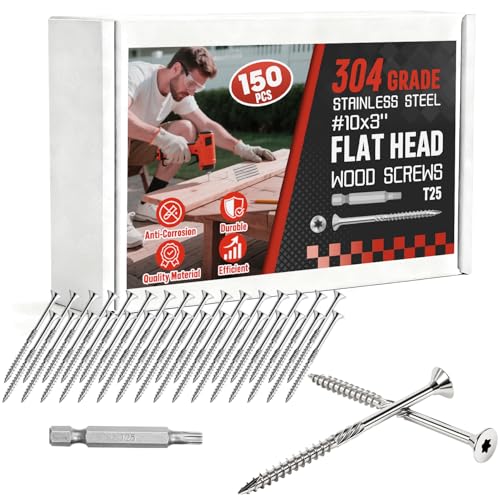
Defeat Rust for Good with 304 Stainless Steel - Tired of rusty screws ruining your project's look and strength? Get screws that stand the test of time. Crafted from premium 304 stainless steel, these construction screws resist corrosion in wet, coastal, and high-moisture environments, delivering lasting performance where ordinary screws fail.

PREMIUM 305 STAINLESS STEEL – #8 x 1-5/8" fence and deck screws built from 305-grade stainless for superior corrosion resistance; ideal for outdoor, marine, and wet-environment projects that need long-lasting rust protection.

BUILT TO LAST WITH 304 GRADE STAINLESS STEEL - These deck screws are made from premium Type 304 (18-8) Grade stainless steel for superior strength, rust resistance, and long-lasting performance in fencing, decking, and all types of outdoor woodwork and construction applications