
How to Create a Picture Frame Deck With Hidden Fasteners
You’ll strengthen your deck frame by adding extra joists inset from the border, then install border boards flush with precise 16-inch fastener spacing. Choose hidden fasteners like Cortex or CONCEALoc systems based on your board profile. Position fasteners within ½ inch of board edges, spacing two to three color-matched screws at miter joints. Maintain ½ to ¾ inch overhangs and apply construction adhesive to corners. Master these foundational steps, and you’re ready to explore advanced finishing techniques that’ll elevate your deck’s professional appearance.
Preparing Your Deck Frame and Joists
Before you install your picture frame decking, you’ll need to strengthen and modify your existing deck frame to support the additional structural demands of the border pattern. Start by adding two extra joists per side, positioning them approximately 1.5″ inset from your border board’s end. Double your perimeter joists and fasten them together with screws for enhanced strength. Maintain 16″ on-center spacing throughout your joist placement. Install structural angle brackets to secure new joists to your rim joist and ledger. For blocking techniques, place solid blocks at all four corners and apply 2″ x 6″ flat blocking at 16″ intervals along the perimeter edge. Use exterior-grade construction adhesive to secure blocks to framing. The specific blocking and joist configuration you choose should comply with local building codes to ensure your deck meets structural requirements. Apply joist tape to protect all framing members before decking installation. When installing your cedar deck boards, pre-drilling is essential to avoid splitting the dense wood and ensure a secure connection.

CARBON STEEL MATERIAL: Our black joist anchor connectors are crafted from high-quality carbon steel Q235B, featuring a black powder coating for enhanced durability and corrosion resistance. This ensures that the connectors maintain stable performance over time and extend their service life, even in harsh environmental conditions.

Made to Last: The face mount 2x6 joist hangers is made of 18 gauge carbon steel and galvanized to prevent rust, ensuring long-term strength and stability. It performs reliably even in harsh climates, including tropical storm areas
Installing Border Boards With Precision
Now that you’ve reinforced your deck frame and joists, you’re ready to install the border boards that’ll define your picture frame pattern. Start by measuring your deck perimeter accurately, accounting for desired overhang and 45-degree mitered corners at each corner.
Position boards flush with fascia or alignment blocks for consistent board alignment. Use spacer blocks to maintain uniform gaps between starter boards and frame. Before fastening, verify boards are straight and test fit your mitered corners for seamless joints.
Install hidden fasteners every 16 inches on center, placing two fasteners per section about 1 inch from each edge. Pre-drill holes if required. Leave proper gaps between mitered boards based on temperature—1/8″ above 40°F, 1/4″ below. This spacing allows for the natural expansion and contraction of composite decking materials across seasonal temperature changes. If any stain or debris gets on nearby vinyl siding during installation, use prompt and effective cleaning methods to prevent permanent marks.
Finally, inspect all joints for even gaps and flush alignment, adjusting any misaligned boards before completion.
Understanding Hidden Fastener Systems
With your border boards installed and mitered corners aligned, you’ll need to select and comprehend the hidden fastener system that’ll secure your picture frame while maintaining its seamless appearance. You’ve got several options: screw and plug systems use matching material plugs to conceal fasteners, while clip systems attach to board grooves for completely fastener-free surfaces.
Your choice depends on your decking profile. Cortex fasteners work with TimberTech full-profile boards, whereas CONCEALoc fasteners require grooved boards specifically. Ensure your starter strip or clip is installed straight and flush with the joists before proceeding with board placement.
For installation tools, you’ll want a pneumatic driver or standard drill with a TORX ttap drive system for superior bit engagement. Consider fastener materials carefully—stainless steel provides excellent corrosion resistance, while plugs manufactured from identical decking material ensure seamless color matching across your entire picture frame border. Consistent fastener spacing across all joists, typically not exceeding 16 inches on center, ensures your picture frame border remains structurally sound and visually cohesive. Using spacers for expansion gaps between boards maintains proper alignment and accommodates material movement.
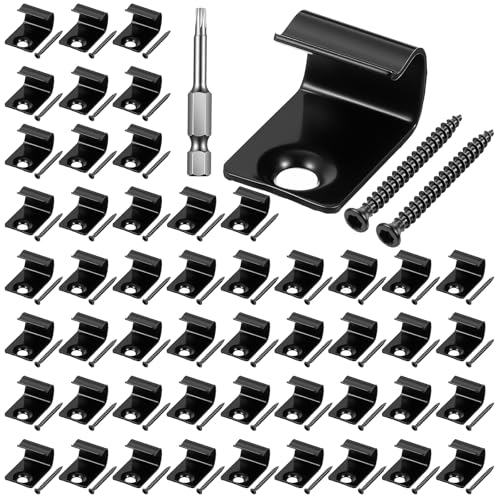
Durable Stainless Steel Material: Starter deck clips are constructed from high-quality 304 stainless steel, which offers strong resistance to corrosion and rust. This ensures...
Proper Fastener Placement and Techniques
Once your mitered corners are cut at precise 45-degree angles and fit tightly without gaps, you’re ready to secure them using proper fastener placement that’ll prevent board movement and maintain your picture frame’s structural integrity. Space two to three color-matched deck screws on each side of the mitered joint, positioning them within ½ inch of the board edge. Evenly distribute fasteners along the joint for ideal load distribution and fastener durability. Pre-drill composite boards before installation; some PVC materials don’t require pre-drilling. Use your universal installation tool to position each fastener precisely, allowing the inverted cone design to guide your driver bit into the exact screw head location. This consistent technique prevents overdrive and guarantees proper engagement for the next board. CAMO fasteners feature a reverse rake tip that removes deck material as it bores to prevent splitting, making them ideal for picture frame applications. For picture frame decks, superior tensile strength of screws makes them particularly effective at preventing decking boards from warping or popping up over time.
100 PCS Picture Frame Turn Button Fasteners: 0.8 inch/2 cm in length, 0.35 inch/0.9 cm in width. Small and simple design basically not affect original appearance.

Secure Your Decor with Ease: When it comes to keeping your home organized and showcasing your valuable decor, finding reliable wall mounting hardware is essential. That's precisely where QUALIHOME double headed wall screw anchors step in. These drywall screws provide exceptional security for all your wall additions, ensuring they remain securely mounted.

ALL-IN-ONE SOLUTION – Hanging tool allows you to visualize nail/hole placement, mark the wall precisely, and position the picture correctly the first time..Note: Measure your door's backset, cross bore and thickness to ensure you find the right fit.
Achieving the Perfect Overhang and Finishing Details
After you’ve secured your mitered corners, attention to overhang dimensions becomes critical for achieving that polished, finished appearance.
Your overhang measurements should range from ½ inch to ¾ inch, depending on your fascia board thickness and decking width. Start measuring from the outside of your framing, then calculate backward based on your board dimensions and desired overhang. For 5½-inch boards, measure back 4½ inches from the framing edge.
Fascia board thickness directly impacts your final result. A ½-inch fascia creates approximately ¼-inch overhang, while thicker boards require adjusted blocking to achieve proper overhang distances. Maintaining proper board spacing throughout your installation ensures consistent aesthetics and functionality.
Apply exterior-grade construction adhesive to your mitered corners for added security. Position fasteners within ½ inch of the corner joint, ensuring they penetrate fully into supporting blocks for maximum holding power and durability. Allow the adhesive to completely air-dry before exposing your deck to moisture or heavy use.