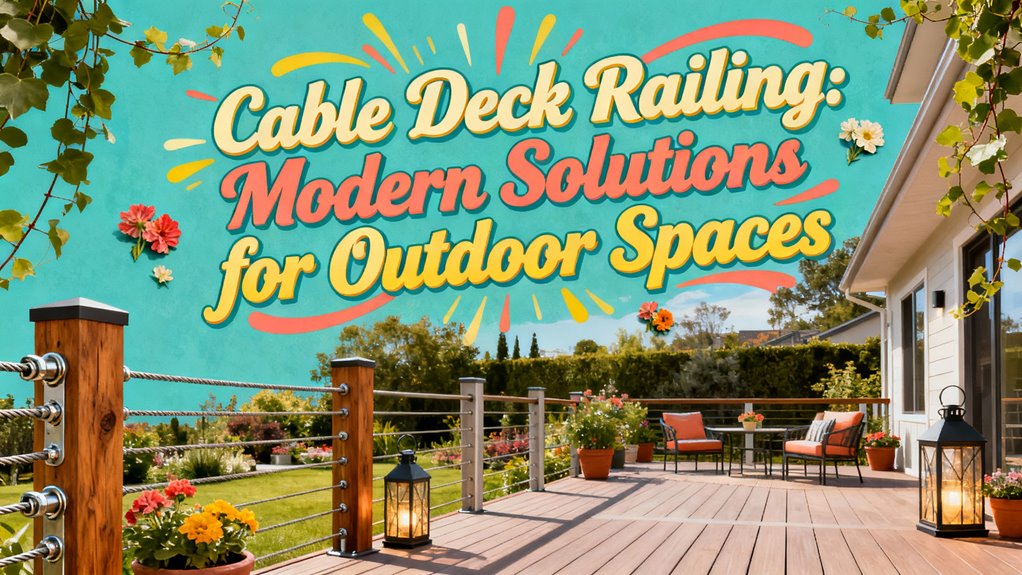
Cable Deck Railing: Modern Solutions for Outdoor Spaces
You’ll transform your deck into a modern architectural statement with cable railings that merge minimalist aesthetics and structural performance. These systems feature eighth-inch stainless steel cables strung horizontally through flat-bar posts, creating near-invisible barriers that maximize sightlines and spatial openness. With marine-grade materials, innovative tension control systems, and compliance with safety standards—including 4 3/8-inch cable spacing and 200-pound load resistance—you’re investing in durability and contemporary design. Uncover how strategic material selection and precision engineering elevate your outdoor environment.
Code Compliance and Safety Standards
Whether you’re installing a residential or commercial cable deck railing, you’ll need to meet specific height, load, and spacing requirements established by the International Residential Code (IRC) and International Building Code (IBC). Residential decks require 36-inch minimum guardrails, while commercial buildings demand 42 inches. Your top rail must withstand 200-pound concentrated loads, and infill must resist 50 pounds per linear foot. Cable spacing can’t exceed 4 3/8 inches to prevent a 4-inch sphere from passing through—a critical safety regulation that you’ll verify during installation and inspection protocols. End posts require robust bracing to handle cable tension. Always consult your local building department, as jurisdictions frequently amend height requirements. Annual re-tensioning and periodic inspections guarantee continued compliance and safety.
Premium Materials and Finish Options
When you’re selecting materials for your cable deck railing, you’re choosing between systems engineered for durability, aesthetics, and minimal maintenance. Your material selection determines performance in specific environments. Marine-grade 316 stainless steel wire rope resists corrosion in harsh coastal conditions, while 2205 duplex stainless steel cable offers enhanced strength for demanding applications.
For posts, you’ll choose between T6061 aluminum for contemporary aesthetics or T316 stainless steel for premium durability. The PCI-4000 certified powder coating process guarantees weather resistance and color variety—including black, white, and silver options—that complement your design vision.
Stainless steel hardware features Quick-Connect technology for tool-free jobsite installation. Protective aluminum sleeves provide seamless appearance while hiding components. To maintain your railing’s appearance and extend its lifespan through seasonal changes, consider applying water-repellent sprays on metal surfaces to create a protective barrier against moisture and oxidation. Additionally, ensure proper ventilation around your railing installation to prevent moisture buildup that can compromise structural integrity. This systematic approach to material selection delivers reliable performance with minimal upkeep requirements.

Marine-Grade Material: Crafted from premium T316 stainless steel, our wire rope boasts exceptional strength, durability, and resistance to rust and corrosion. Designed to withstand the harshest outdoor elements, this marine-grade stainless steel cable improve reliability for all your indoor and outdoor applications.

316 stainless steel features strong weather resistance, You can cut it to the required length to your needs,It with 30Pcs crimping loop sleeve and 10Pcs thimble can protect the wire rope to reduce wear and prolong the service life

Marine-Grade Material: Crafted from premium T316 stainless steel, our wire rope boasts exceptional strength, durability, and resistance to rust and corrosion. Designed to withstand the harshest outdoor elements, this marine-grade stainless steel cable improve reliability for all your indoor and outdoor applications.
Contemporary Design Aesthetics
Today’s cable deck railings define modern outdoor spaces through their marriage of visual minimalism and sophisticated material expression. You’ll appreciate how black finishes create striking contrasts with warm wood tones like Ipe, establishing modern elegance across your outdoor deck. The tensioned stainless steel cables deliver unobstructed sight lines that preserve scenic views while maintaining clean aesthetics.
Your design versatility expands when you pair cable systems with natural hardwoods and composite decking. Horizontal cable layouts contribute to streamlined, open-air environments that reduce visual clutter. Wood handrails atop black posts balance industrial materials with tactile warmth, achieving contemporary sophistication without sacrificing functionality. Cable spacing must comply with baluster spacing requirements to ensure safety and prevent hazards.
Modular systems accommodate your specific architectural requirements, enabling customized solutions that respect unique deck layouts while supporting sustainable design principles through durable, long-lasting materials. Cable railing systems must meet safety load requirements and be tested and certified to comply with building codes adopted in your region.
Fast and Simplified Installation Methods
Once you’ve selected your cable railing system, the installation process becomes straightforward through systematic preparation and methodical execution. You’ll streamline installation techniques by using a drilling template—a 4-inch-wide plywood strip with 1/4-inch holes spaced 3 inches apart—ensuring consistent alignment across all posts.
Time savings emerge when you prepare blocking between joists beforehand and secure corner posts first, then use mason’s lines as guides for field posts. Drilling halfway through each post, then from the opposite side, prevents misalignment and accelerates the process.
You’ll further optimize efficiency by passing cable through all posts simultaneously with adhesive washers and protective sleeves. Alternating tensioning from center outward maintains balanced pressure while reducing adjustments. For posts constructed from wood materials like mahogany, ensure the natural resistance to rot of your chosen wood is maintained through proper sealing during installation. After installation is complete, maintain your railing’s appearance by routinely removing debris with a leaf blower and spot cleaning with appropriate outdoor cleaners. This systematic approach delivers professional-quality railings without unnecessary complexity or extended timelines.
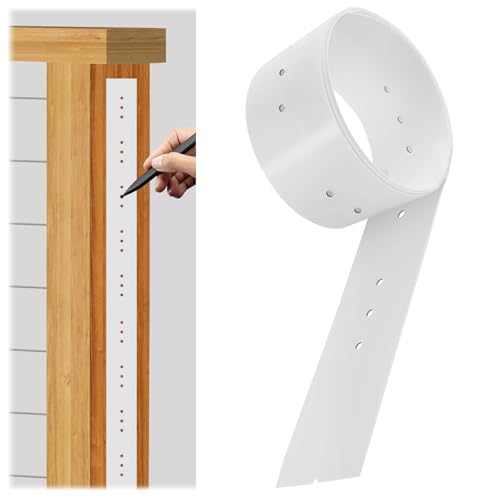
DIY Plastic Template Strip for Railing System: Our 42-inch plastic template strip simplifies your undrilled cable railing post installation. Pre-drilled for easy measurement and drilling, this template saves time and effort for a smooth DIY experience.

Precise 90° Vertical Drilling: Ensure perfectly straight holes every time with our 30/45/90 degree angle drill guide jig. The built-in bubble level guarantees vertical accuracy, making it the essential drill guide for hand drill applications on stair railings, deck posts, and fine woodworking joints

【Angle Drill Guide for Straight Holes】The angle drill block for straight holes is a 90 degree drill guide, which is very accurate for the drill block for straight holes
Structural Durability and Weather Resistance
Because your cable railing system will face constant environmental stress, selecting appropriate materials directly determines its longevity and safety performance. You’ll want to prioritize Type 316 stainless steel for exterior installations, as it offers superior corrosion resistance due to its highest nickel content. This material withstands moisture, salt spray, UV exposure, and temperature fluctuations better than alternatives.
Your material selection should also include 1×19 strand cable construction for maximum rigidity and minimal stretch. You’ll maintain structural integrity by combining stainless steel cables with powder-coated aluminum posts and UV-resistant components like Delrin grommets.
Regular maintenance preserves durability—you’ll need periodic re-tensioning, corrosion inspections, and hardware checks. This systematic approach guarantees your system meets safety codes while resisting environmental degradation effectively.
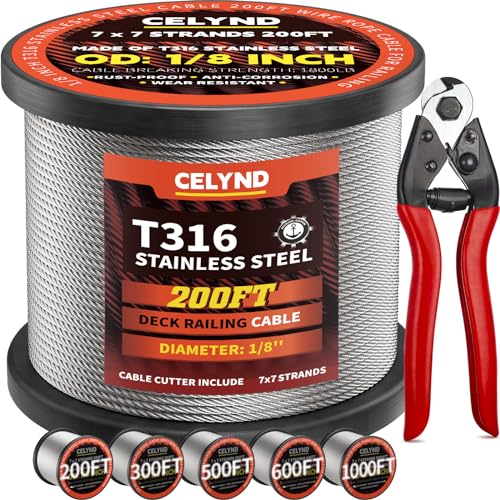
Marine-Grade Material: Crafted from premium T316 stainless steel, our wire rope boasts exceptional strength, durability, and resistance to rust and corrosion. Designed to withstand the harshest outdoor elements, this marine-grade stainless steel cable improve reliability for all your indoor and outdoor applications.

High-grade Material: These adjustable cable railing system is integrated design suitable for 1/8” stainless steel cable and made of high quality T316 marine grade stainless steel, durable, anti-corrosion, anti-rusty and it can work whatever the weather is

【STRONG CABLE】 Marine Grade 316 Stainless Steel has the highest corrosion protection, strong, stable, anti-fatigue, weather resistance, heat resistance, corrosion resistance. Also, our 7 x 7 structure wire rope uses heavier gauge wire and offers better abrasion resistance.
Cable Spacing and Load Requirements
While material selection and maintenance establish your system’s foundational durability, proper cable spacing and load requirements determine whether your railing actually performs its safety function. You’ll maintain 3 ⅛ inches on center spacing to comply with the 4-inch sphere rule, ensuring no gaps allow passage of a standard safety sphere. Your cables must withstand a minimum 200-pound load without excessive deflection. For standard 4-foot post spacing, this spacing standard applies directly. However, you’ll reduce cable spacing by ¼ inch for every foot exceeding 4 feet between posts. Proper tensioning prevents deflection-related failures, requiring gradual tension adjustments from the center cables outward to ensure even pressure distribution. You may incorporate cable stabilizers for spans up to 7 feet, allowing extended post spacing while maintaining safety integrity throughout your deck railing system. Just as proper stain application requires attention to environmental conditions and technique to ensure durability, your cable railing system demands meticulous installation and maintenance to preserve its protective function over time.
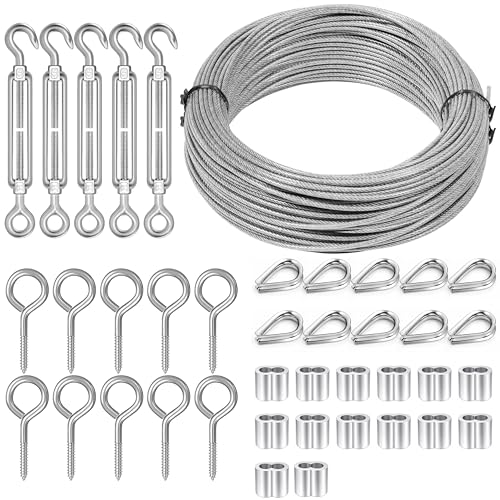
PREMIUM WIRE TURNBUCKLE KIT: Includes 100Ft 1/16 Inch robust stainless steel cable and 5pcs M5 adjustable turnbuckles,10pcs M2 wire rope thimbles, 10pcs M5 screws hooks, and 20pcs M2 aluminum crimping loops designed for secure tensioning in various wire installations; ensures strong, durable support for your projects

【Applications】Swage lag screw system is a streamline stainless steel wire balustrade systems for straight, stair or angled sections. BLIKA high-quality stainless steel wire balustrade hardware that is suitable for indoor and outdoor applications. Cable railing swage lag screws perfect for planning your DIY cable railing project, staircases, balconies and decking areas. Get the job done effortlessly with our extra-thick wrench—built to outlast others.
![[Patent] Muzata 20Pack Cable Railing Hardware Tensioner & Terminal CR26](https://m.media-amazon.com/images/I/41wPgXjx7pL._SL500_.jpg)
Patented Invisible Design for 4"x4" Wood Post: With the patented invisible flattened tail design, the ugly swaged end can be hidden in the 4"x4" wood post(but cannot be hidden in 2"x2" posts), and get enough tension to pass 4”sphere test to meet code compliance. The customized socket wrench Muzata CT16 is essential for the invisible installation and keeps the cable from spinning when tightening. Package includes: 10 pairs of tensioners and terminals, 1pc allen wrench, 1pc socket wrench
Minimalist Visual Impact and Open Sightlines
How do you maintain unobstructed sightlines while meeting rigorous safety standards? Cable railing systems solve this design challenge through strategic material selection and engineering. Eighth-inch stainless steel cables create near-invisible barriers that preserve visual aesthetics without compromising safety compliance. Flat-bar posts as small as ⅜” profile minimize vertical obstruction, while horizontal cable orientation maximizes viewing areas between structural elements.
Marine-grade 316-type stainless steel and powder-coated aluminum blend seamlessly with natural landscapes and architectural elements. Black stainless and white powder-coated finishes offer design flexibility for contemporary aesthetics. This sightline enhancement approach extends perceived living space into outdoor environments, creating spatial openness. Cable railing systems typically require closer spacing of around 4 feet on center to prevent cable sagging and maintain tension while preserving the minimalist appearance. Proper fastener placement and alignment ensures cable systems remain secure and visually seamless across your deck surface. Code-compliant cable spacing maintains structural integrity while preserving the minimalist appearance you’re seeking for your deck system.
Innovation in Tension Control Systems
Proper cable tension isn’t just a maintenance detail—it’s fundamental to your railing’s safety, longevity, and appearance. Centralized tensioning systems like the OneTen™ built-in tension control system revolutionize traditional approaches by eliminating individual cable adjustments. You’ll experience approximately 38% faster installation compared to conventional methods while maintaining uniform cable performance across your entire railing.
These innovative systems minimize seasonal maintenance by reducing periodic re-tensioning caused by temperature fluctuations and structural movement. Pre-assembled kits with pre-installed brackets and pre-strung cables facilitate consistent tension adjustment without manual fine-tuning of each cable. By centralizing tension control, you achieve superior railing performance and extended system longevity while simplifying ongoing maintenance requirements and reducing installation complexity considerably. Cable railing systems must comply with baluster spacing requirements to ensure safety and prevent passage of small objects through the railing. Once your deck exceeds 30 inches in height, building codes mandate the installation of a railing for safety reasons.

Vertical tension wire display system

Horizontal tension wire display system

🔦【Compatibility】These threaded swage stud fittings end terminals for 1/8" wire rope cable, suitable for 2x2 Wood or Metal Posts. Swage Threaded Stud includes washer and lock nut. Perfect for installing a DIY deck cable railing system project, excellent for both outdoor and indoor application.( wood, steel, aluminum post on deck railing).