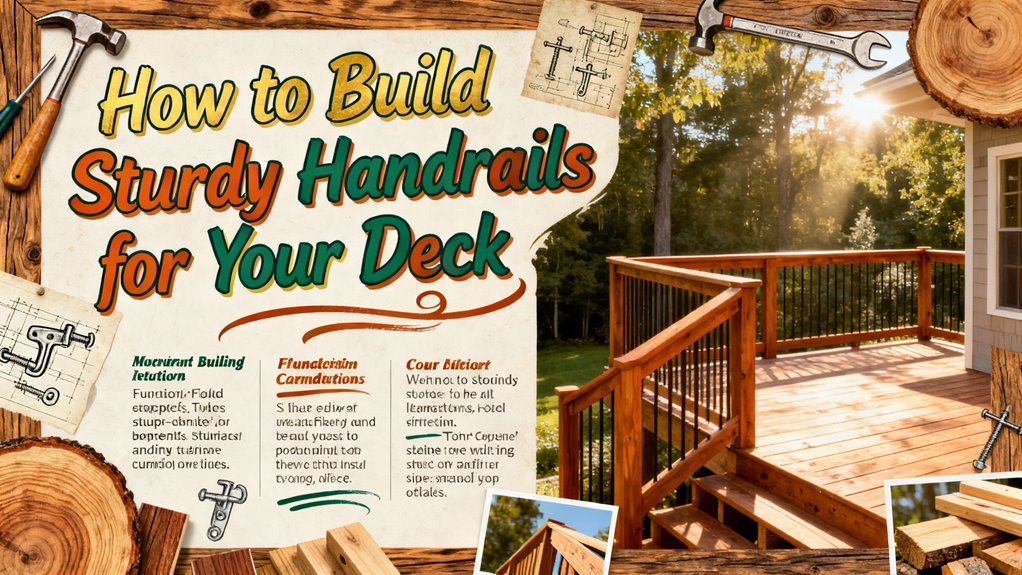
How to Build Sturdy Handrails for Your Deck
You’ll need to build handrails that meet your local height requirements—typically 36 inches for decks or 34-38 inches for stairs. Install 4×4 posts no more than 6 feet apart in concrete footings below the frost line. Use corrosion-resistant fasteners and secure posts with four through bolts minimum. Your handrails must withstand 200 pounds of concentrated load in any direction. Select materials like composite or stainless steel for durability. Space balusters within 4 inches to prevent sphere passage. Following proper installation and maintenance techniques will guarantee your railing system remains safe and code-compliant for years.
Understanding Handrail Height Requirements
Safety hinges on proper handrail dimensions. You’ll find that most residential deck handrails must measure at least 36 inches tall, calculated vertically from the deck surface to the rail’s top. However, height variations exist depending on your location and deck type. Some states like California and Washington mandate 42 inches minimum. Stair handrails follow different specifications—they’re typically 34 to 38 inches high, measured from the stair nosing. For ADA-compliant installations, you’ll need 34 to 38 inches with continuous extensions beyond stairs. Commercial decks often require taller railings. Guardrail openings must not allow passage of a 4-inch diameter sphere to prevent falls and ensure safety. Since local codes vary considerably by municipality, you should verify requirements with your building authority before installation to guarantee compliance and safety. Well-designed handrails can also contribute to defining outdoor areas with style, much like the structural elements that enhance backyard functionality.
Meeting Load Capacity Standards
While proper height guarantees your deck meets code requirements, you’ll find that load capacity standards are equally critical to structural integrity and user safety. Your handrails must support a 200-pound concentrated load applied in any direction and withstand 50 pounds per linear foot of distributed force. During load testing, inspectors apply forces vertically, horizontally, and laterally at multiple points: the top, mid-span between posts, adjacent to posts, and directly on posts. You’ll need to space posts no more than 8 feet apart and use robust materials like 2″ x 2″ structural metal angle iron with adequate thickness. Handrails must also be continuous from the top riser to the bottom riser to ensure consistent support throughout the structure. These specifications maintain your railing’s structural integrity under realistic stress scenarios, protecting occupants from falls and failure. In New Jersey, handrails on exterior corridors must also meet height requirements of 36 inches minimum for any balcony, landing, or porch with more than a three-foot drop.
Selecting Appropriate Materials
Now that you’ve understood the structural requirements for your handrails, you’ll need to select materials that can consistently meet those demanding load capacity standards while fitting your budget, climate, and maintenance tolerance. Conduct a thorough material comparison between wood, vinyl, composite, aluminum, and steel options. Wood offers affordability and traditional aesthetics but demands frequent maintenance, similar to how deck stain requires reapplication every few years to maintain protection and appearance. Vinyl and composite provide excellent durability with minimal upkeep, and polypropylene-based composites offer exceptional weather resistance to withstand sun, rain, and moisture without significant fading or damage. Aluminum delivers lightweight strength and customizable finishes, though it struggles in coastal environments. Stainless steel excels in harsh climates and corrosion resistance at premium pricing. Consider your aesthetic preferences alongside environmental factors in your region. Align your selection with your long-term maintenance commitment and financial constraints to guarantee sustainable performance and satisfaction.

Marine-Grade Material: Crafted from premium T316 stainless steel, our wire rope boasts exceptional strength, durability, and resistance to rust and corrosion. Designed to withstand the harshest outdoor elements, this marine-grade stainless steel cable improve reliability for all your indoor and outdoor applications.
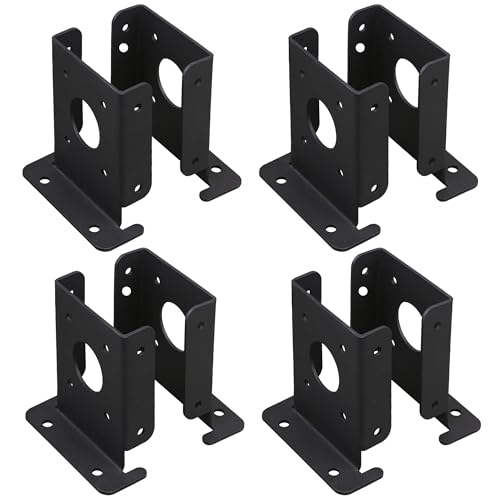
Strong and Sturdy - The fence post anchor base brackets is made of metal,black powder coating is uniform with complete coverage to ensure long-lasting use in a variety of outdoor conditions.It can hold your fence posts,pergolas,deck handrail rails.
Designing Proper Handrail Dimensions
Once you’ve selected your materials, you’ll need to verify your handrail dimensions comply with building codes and provide safe, comfortable gripping for users. Your handrail shape directly impacts functionality and safety. Circular handrails must measure 1¼ to 2 inches in diameter, while noncircular designs require a minimum 4-inch perimeter with a 2¼-inch graspable dimension for perimeters between 4 and 6¼ inches. Maintain continuous, smooth surface finishes for comfortable gripping. Position your handrail 34 to 38 inches above stair tread nosings, measured vertically. Ascertain at least 1½ inches of clearance from walls, and don’t allow the handrail width to project more than 4½ inches from the wall. Handrails must also be able to resist a 200-pound load applied in any direction to ensure structural safety. These precise dimensions guarantee accessibility and user safety during stair navigation. Remember that deck height requirements determine whether a railing is necessary in the first place, as railings become mandatory once your deck exceeds 30 inches above grade level.

Pipe Stair Handrail:Made of aluminum, it has strong corrosion resistance, is not prone to rust, and is sturdy and fade-resistant. The black powder coating keeps the staircase handrail smooth and safe, providing traction to prevent slipping and offering support as you climb stairs, preventing injuries from falls and slips

[PREMIUM 304 STAINLESS STEEL] Constructed from high-density 304 stainless steel, providing excellent strength and durability. This material is designed to resist oxidation and corrosion, making it perfect for long-term use in both dry and humid environments.

Material: Made of high-quality 316-grade stainless steel, known for its excellent corrosion resistance, especially in marine environments or areas with high humidity.
Spacing Posts and Balusters Correctly
Because improper spacing compromises both the structural integrity and safety of your deck railing system, you’ll need to carefully plan post placement before installation begins. For standard wood railings with 4×4 posts, space them no more than 6 feet apart on center to guarantee adequate post stability. If you’re using 6×6 posts, you can extend spacing to 8 feet on center. However, cable railing systems demand tighter spacing—typically 4 feet on center—to prevent sagging and maintain proper tension. For infill spacing, balusters must not exceed 4 inches apart, preventing a 4-inch sphere from passing through. Space between decking and your bottom rail also can’t exceed 4 inches. Handrails on stairs with four or more risers must be positioned between 34 and 38 inches above the stair tread nose and remain continuous for the full length of the stairs. These measurements guarantee your railing meets safety codes while maintaining structural integrity. Additionally, guardrails must meet the 36-inch minimum height requirement to ensure adequate protection for deck users.

Wide applications: This 26" round aluminum baluster can be used to build a 36" wood and composite deck railings, creating a stable, stylish look. It can be easily cut to different heights to suit various needs. In addition, its 3/4" diameter allows it to be compatible with most baluster connectors or shoes on the market

【EVERYTHING YOU NEED IN ONE BOX】 Get started right away with our complete kit: 105 elegant round balusters (26" x 3/4"), 210 straight connectors, 30 angled connectors(30 degree), all necessary screws, and a professional-grade screw bit. Perfect for creating stunning 36" rail heights on both level and stair applications.

Real 6063 Aluminum — Install Once, Skip Rust Headaches: A quick magnet test shows the difference—iron or steel attracts the magnet; Guwezoy 6063 aluminum does not. Iron or steel may develop red rust within 6 months–2 years, staining your deck as corrosion spreads and weakens the railing, leading to sagging, cracking, or early failure. With 6063 aluminum and an AAMA 2604 textured finish, Guwezoy is built for 30+ years outdoors with less sanding and repainting, so you can enjoy your deck more.
Ensuring Building Code Compliance
While post spacing and baluster placement form the foundation of a safe railing system, you’ll also need to meet specific building code requirements that govern height, load capacity, and opening restrictions. Your handrail regulations demand a minimum 36-inch height for residential decks, though some states require 42 inches. Commercial properties always mandate 42 inches. You must verify your handrail supports concentrated 200-pound loads in any direction and maintains openings no larger than 4 inches to prevent passage of a sphere. Code enforcement officials will verify your handrail diameter ranges between 1¼ and 2 inches for circular designs, with minimum 1½-inch clearance from walls. Stair railings typically need to be between 34 and 38 inches high to meet IRC standards. In California specifically, deck permits are typically required if your deck is attached to a home, exceeds 200 square feet, or is elevated more than 30 inches. Check local regulations before construction, as code enforcement varies by jurisdiction and can affect your entire installation.
Preparing Your Foundation and Footings
You’ll establish a durable handrail system by starting with a solid foundation that resists frost heave, ground settling, and structural movement. Begin by clearing debris and leveling the ground using proper deck leveling techniques to create a stable base. Compact the soil thoroughly—understanding your foundation soil types determines footing depth requirements. Mark footing locations according to local codes, spacing them at corners and along the perimeter. Dig holes below the frost line and install either poured concrete footings or concrete blocks. Fill with wet concrete and allow adequate curing time. Lay landscape fabric as a weed barrier, then spread 4–6 inches of compacted crushed stone for drainage and stability. Once your foundation is set, secure your 4×4 posts using corrosion-resistant fasteners to tie them back into the joist framing, ensuring they can withstand the required loads for handrail safety. Before fastening deck boards, check that all posts are properly leveled and plumb using a post level to verify vertical alignment. This preparation prevents movement and guarantees your handrails remain secure.

304 Stainless Steel Construction: Providing corrosion resistance for compatible concrete fastening applications in indoor and outdoor locations.

Dacromet Anti-Corrosion Coating: Black Dacromet coating offers superior rust protection for outdoor structures, outperforming standard painted or zinc-coated fasteners.

Versatile Cable Tensioning: This black deck railing hardware kit is specifically designed for 1/8 inch diameter cable railing systems, the lag screws could be drilled into wood to adjust the tightness without extra turnbuckle or tensioner. The left and right thread ensure that cables rotate in the same direction, preventing any twisting or damage, providing a smooth and secure cable railing installation.
Installing Secure Connections and Hardware
Properly securing your handrail system hinges on selecting the right fasteners and hardware for your specific materials and environment. You’ll want corrosion-resistant fastener types like stainless steel or hot-dipped galvanized options, especially for outdoor exposure. Specialized systems such as ThruLOK fasteners simplify installation without pre-drilling.
For connection techniques, position brackets precisely on posts and secure them with manufacturer-provided hardware. When spanning multiple posts, verify each joint has underlying post support. Pre-drill all holes to prevent wood splitting and maximize fastening strength. The railing angle should be measured and cut to align parallel with the stair slope to ensure both safety and proper aesthetics.
Use clamps to hold handrails plumb and level during fastening. Verify alignment with a level before final tightening. For stair applications, install minimum four through bolts per post with offset holes to avoid collisions and guarantee maximum structural integrity throughout your deck railing system. All handrails must have specific grip dimensions to ensure safe and comfortable use for all users.
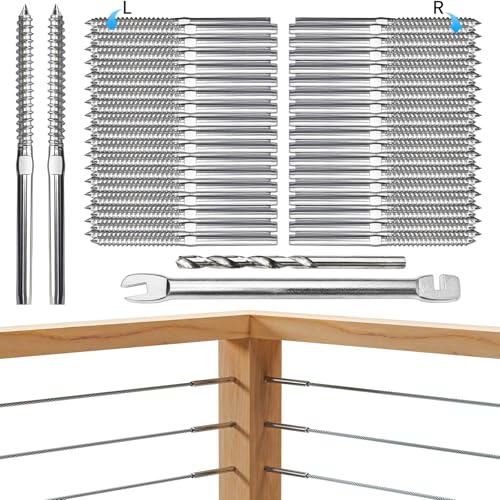
Versatile Cable Tensioning: This deck railing hardware kit is specifically designed for 1/8 inch diameter cable railing systems, these Swage Lag Screws are the ultimate solution for effortlessly adjusting cable tension. The left and right thread ensure that cables rotate in the same direction, preventing any twisting or damage, providing a smooth and secure cable railing installation.
Versatile Cable Tensioning: This black deck railing hardware kit is specifically designed for 1/8 inch diameter cable railing systems, the lag screws could be drilled into wood to adjust the tightness without extra turnbuckle or tensioner. The left and right thread ensure that cables rotate in the same direction, preventing any twisting or damage, providing a smooth and secure cable railing installation.

Package Includes: you will receive 80 pack 3/16” stainless steel invisible receiver swage stud, comes with wrench, sufficient quantity provides support for the completion of your project
Maintaining Your Handrails for Longevity
Once you’ve installed your handrails with secure fasteners and proper alignment, the real work begins—maintaining them so they stay safe and attractive for years to come. Implement regular cleaning techniques using mild, material-appropriate cleaners and microfiber cloths weekly or biweekly. For tough stains, apply a vinegar-water solution followed by thorough rinsing and drying.
Conduct biannual inspections in spring and fall, checking posts for levelness and examining joints where railings meet your deck. Our repair tips include promptly tightening loose fasteners, replacing corroded hardware, and addressing cracked or splintered sections immediately. For wood railings with paint damage or deterioration, consider using chemical paint strippers to remove old finishes before resealing. Apply water-repellent sealants to wood railings every 2-3 years. In harsh climates, increase maintenance frequency and remove snow or standing water promptly to prevent moisture damage and deterioration.
Since handrails are often constructed from the same pressure-treated lumber used in deck substructures, applying appropriate sealants protects against the same environmental factors that affect your deck’s frame.