Selecting the Right Pergola Beam Size for a 16′ Span
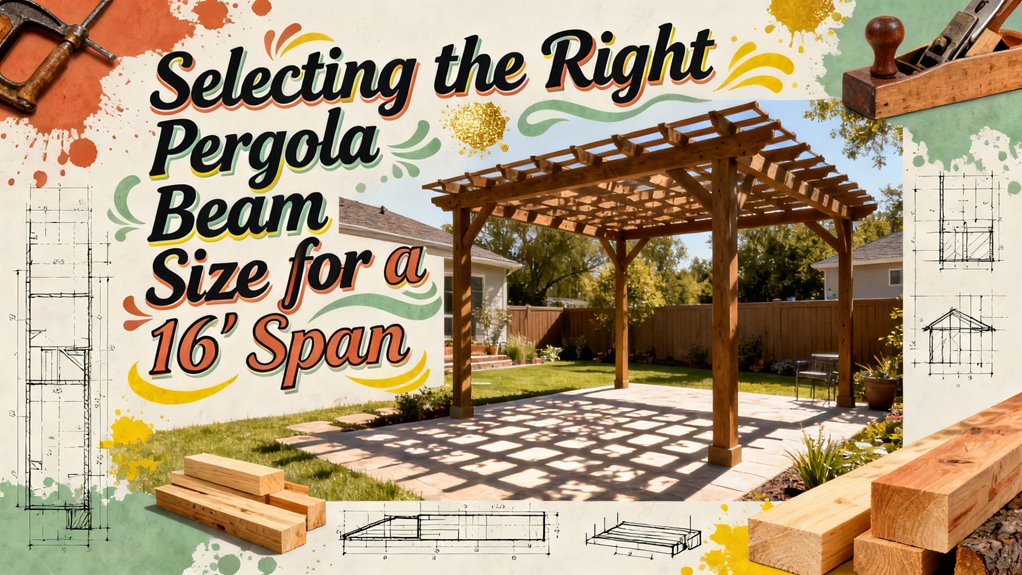
For your 16-foot span, you’ll need a beam depth of approximately 12.8 inches using the span-to-depth formula. Common options include double 2×12 wood beams, 3×12 glulam, or an 8×10 steel I-beam. Your choice hinges on dead loads (5-10 PSF), live loads (minimum 20 PSF), and regional snow requirements. Douglas Fir-Larch outperforms Spruce-Pine-Fir in load capacity. An 18-inch overhang adds roughly 3 feet to your total beam length. Balancing structural integrity with aesthetic design requires strategic material selection and proper installation techniques.
Understanding Beam Size Recommendations for 16-Foot Spans
When you’re sizing beams for a 16-foot pergola span, material selection becomes your primary driver—it’ll determine both the dimensions you need and the structural performance you’ll achieve. Using the span-to-depth formula, you’ll calculate beam depth at approximately 12.8 inches (192 inches ÷ 15). A standard wood beam for this span measures 6″ wide by 14″ deep, while glulam alternatives often require only 3″ x 12″ dimensions. Steel I-beams typically measure around 8″ x 10″ depending on load specifications. You must validate your choices against span tables and local building codes, as beam width and beam depth directly impact deflection limits and long-term durability. For a 16-foot span with 2×12 lumber, double beams fastened together are recommended to ensure adequate load capacity and minimize deflection. Beams spanning this distance significantly exceed typical maximum unsupported spans, making proper engineering and support critical to prevent sagging and structural failure. Engineer consultation guarantees code compliance for your specific conditions.

Premium Solid Cedar Wood Frame: Crafted from high-quality cedar wood with rich grain patterns, this pergola features a natural finish and is treated with a weatherproof stain for long-lasting durability, ensuring protection through all seasons

[Premium Quality Materials] Constructed with a robust aluminum frame and galvanized steel louvers, the Domi 10x16FT louvered pergola is designed to withstand various weather conditions. Durable and weather-resistant, it ensures long-lasting performance and enjoyment in your outdoor space.

ULTIMATE BEAM SPLICING SOLUTION - Need to join two 16-foot wood beams together? These heavy-duty straight plates provide the exact rigid support required for long timber extensions, eliminating sagging and joint failure
Load Considerations That Affect Your Beam Selection
Because beam capacity directly determines whether your pergola’ll safely support seasonal stresses and structural weight, you’ll need to analyze both dead and live loads with quantitative precision. Dead loads—typically 5-10 pounds per square foot for wood pergolas—represent permanent structural components. Live loads account for temporary forces like snow and wind, starting at minimum 20 pounds per square foot but varying greatly by region.
Your load distribution strategy requires seasonal adjustments based on local climate data. Snow loads dramatically increase winter demand, necessitating stronger beam specifications in northern climates. Engineered wood products like LVL provide superior strength-to-span ratios for 16-foot spans, outperforming standard lumber species. Proper post base installation with concrete footings ensures that your support structure can reliably transfer these loads to the ground. When planning your design, consider incorporating adjustable shading elements such as retractable canopies or shade sails that can reduce wind loads during severe weather. Consult regional snow load maps and building codes to establish accurate load parameters. This quantitative foundation guarantees your beam selection prevents structural failure under peak conditions.
Calculating Total Beam Length and Overhang Requirements
Accurate beam dimensioning hinges on a straightforward calculation: you’ll add your desired overhang to the post-to-post distance to determine total beam length. For your 16′ span, applying standard 1’6″ overhang dimensions per side yields 19′ total beam length (16′ + 3′). This formula—post-to-post distance + (2 × overhang)—applies uniformly across attached and freestanding pergolas.
You’ll want to verify your overhang dimensions align with your kit specifications, as manufacturers often prescribe exact requirements. Typical overhang ranges from 12″ to 24″ per side, with 18″ representing the industry standard. Maintaining consistent overhang dimensions on both ends ensures structural balance and aesthetic symmetry. However, be aware that beam spans exceeding 6 feet require careful consideration of larger or multiple beams to prevent sagging and maintain structural integrity. Excessive overhang increases beam loading and sagging risk, so adhere to recommended specifications for peak performance. Proper support also depends on having adequate footing depth beneath your posts to ensure the pergola remains stable and level over time.

【Durable for Year-Round Use】 Constructed with an aluminum frame and 5 mm thick polycarbonate hardtop canopy roof, this wall-mounted gazebo is designed to resist UV rays and common harsh weather. The sturdy roof is rated to support 55 lb/㎡ snow load, providing stability in conditions like 4-inch snow in winter, making it an ideal patio pergola.

Durable: High-performance powder-coating aluminum frame provides superior strength, durability, and easy to maintain.

【Double Top in Galvanized Steel】Featuring dual-layer top, the gazebo provides better airflow and ventilation compared with single-layer. The heat insulation layer can block most sunlight and reduces heat. It is double-layer water leak proof and can be used all-weather. Reasonable roof slope design can also make water flow out quickly to prevent rainwater from gathering
How Wood Species and Grade Impact Structural Performance
Once you’ve calculated your beam dimensions, you’ll need to select the right wood species and grade—decisions that’ll directly determine whether your pergola can safely support its intended load. Wood density directly correlates with load-bearing capacity; Douglas Fir-Larch outperforms Spruce-Pine-Fir markedly for heavy spans. Lumber grades establish structural integrity through measurable standards: Select Structural offers superior performance, while No. 2 grade permits larger knot effects—up to 3½ inches—reducing capacity. Grain angle critically impacts strength; steep deviations weaken structural performance. Knot effects vary by grade: No. 1 allows 2¾-inch knots versus No. 2’s larger allowances. For 16-foot spans specifically, you may need to consider doubling beams or upgrading to larger dimensional lumber like 2x8s to achieve the structural capacity required for safe performance. The cost of materials varies significantly based on wood species selection and grade, with premium grades commanding higher prices that reflect their superior structural properties. Species selection proves as critical as grade stamps when evaluating framing lumber performance, directly affecting your pergola’s reliability and labor costs safety margin.
Balancing Structural Safety With Design Aesthetics
While you’ve selected a species and grade that’ll handle your pergola’s loads, you’re now facing a practical reality: the beam size required for structural integrity doesn’t always align with your design vision.
A double 2×12 delivers the necessary load capacity for 16′ spans with minimal deflection, yet you might prefer the refined aesthetic of engineered glulam beams. Your beam architecture directly impacts visual harmony—larger beams project boldness; smaller profiles suggest sophistication. Standard rafter spacing of 18 inches apart ensures consistent load distribution across your pergola structure.
Consulting a structural engineer quantifies these trade-offs. They’ll validate whether decorative beam caps or corbels maintain safety while enhancing appearance. Engineered wood solutions enable longer spans with slighter profiles, reducing sag risk by 15-20% compared to solid lumber while preserving design intent. Strategic notching or recessing—when structurally permissible—creates cleaner visual lines without compromising performance metrics. Proper post base brackets and anchoring systems ensure your chosen beam design performs safely over the long term.
Using Calculators and Resources for Precise Beam Sizing
Now that you’ve weighed structural requirements against design preferences, you’ll need quantifiable data to validate your beam choices. Online calculators from sources like AWC and PLIB provide precise span calculations by processing beam size, wood species, load type, and span length inputs. For your 16′ span, you’ll find that doubled 2×10 beams reach maximum capacity, while single beams fall short. Calculator functionality streamlines complex formulas—specifically, span = ∛[(8 × E × I)/(25 × w)]—eliminating manual computation errors. These tools deliver bending strength, shear strength, and bearing strength specifications tailored to regional wood grades. Pressure-treated lumber is often recommended for outdoor structural applications to ensure longevity and resistance to decay. Similar to how hidden fasteners create a seamless appearance in composite decking installations, proper beam sizing and installation techniques contribute to both the structural integrity and visual appeal of your pergola. By leveraging data-driven results, you guarantee design longevity while meeting local building codes. Cross-verify calculator outputs across multiple platforms to confirm your final beam specifications, establishing a quantitative foundation for structural integrity.

【ABOVE 1500HRS SALT SPRAY TEST】FIXLINK wood screws have passed about 1500 hours salt spray test provide exceptional protection against rust and corrosion, specifically designed to work best with either pressure-treated lumber or composite decking. These deck screws for exterior can be exposed to the sun, humidity, rain, and snow conditions for a long time

DOUBLE-SHEAR NAILING: each joist nail passes through two points for greater strength, allowing fewer nails and faster installation

Self-Drilling Point: Together, coarse screw threads and a self-drilling point design eliminate the need for a pilot hole