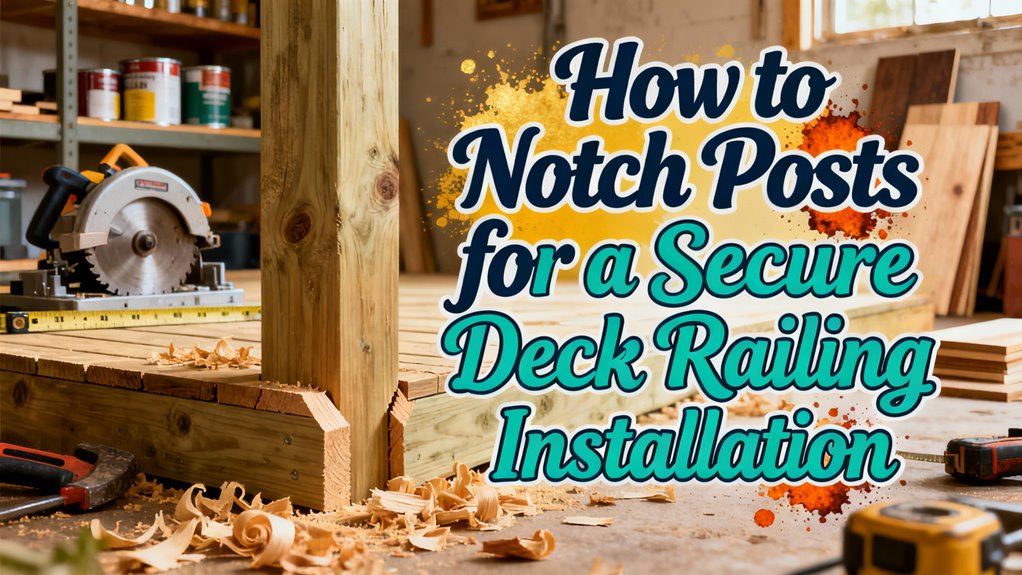
How to Notch Posts for a Secure Deck Railing Installation
You’ll notch deck railing posts by creating recessed cutouts that enhance mechanical interlock and component seating. However, you must carefully balance structural benefits against integrity risks, since reducing the post’s cross-sectional area weakens load-bearing capacity. Modern building codes restrict notching at connection points to prevent lateral movement and guarantee compliance with IRC load requirements. You’ll need precise measuring tools, cutting equipment, and proper fastening hardware like through-bolts. Understanding the complete installation process reveals critical safety considerations you shouldn’t overlook.
Understanding Post Notching and Structural Integrity
When you notch a deck railing post, you’re creating a recessed cutout that allows railing components or beams to seat within the post rather than rest on its surface. This approach enhances mechanical interlock and considerably improves lateral support by reducing post movement.
However, notching reduces the post’s cross-sectional area, potentially weakening its load-bearing capacity if cut too deep. You must balance structural benefits against integrity risks. Structural codes like the NDS and IRC restrict notching on load-bearing posts for this reason.
Post reinforcement through metal connectors becomes essential when notching is involved. Additionally, moisture management is critical—cut areas create pathways for water intrusion that promote rot and decay. You’ll need AWPA M4 preservatives to protect notched sections and maintain long-term durability. For outdoor structures exposed to the elements, considering protective features like retractable canopies can further shield your railing installation from weather-related deterioration. Regular inspections should identify any signs of wear such as rot or splintering at notched areas to ensure the railing remains structurally sound.
Why Modern Building Codes Discourage Notching
Because notching removes critical wood material from load-bearing posts, modern building codes have increasingly restricted or eliminated the practice entirely. You’ll find that the 2021 IRC explicitly prohibits notching at connection points where posts support overhead loads. This restriction exists because notched sections create weak links vulnerable to rotation and lateral movement under pressure.
You should understand that notch limitations directly address structural failure risks. When you remove material from a post’s cross-section, the remaining wood can’t safely meet load requirements specified in IRC Table R301.5. The concentrated 200-pound load requirement and 125-pound-per-foot uniform load resistance become compromised. Additionally, rim joist attachments become failure points when inadequate material remains at the connection interface. Proper deck railing posts should be spaced no more than 6 feet apart to maintain structural integrity and prevent the need for compromised notching solutions. Beyond spacing considerations, guardrails must meet a minimum 36-inch height requirement to ensure adequate safety protection. Bolts and fasteners simply can’t compensate for lost wood area, making structural failure increasingly likely.
Proper Post Placement Techniques
Proper post placement establishes the structural foundation for your entire railing system, and you’ll need to follow precise positioning guidelines before you drill any fastener holes. Start by consulting your deck plans to identify required post positions, with posts required at each corner for maximum stability. Space remaining posts evenly with maximum 6-foot spacing between them, positioning posts 4 to 6 feet apart to guarantee your railing withstands lateral forces effectively. Use your measuring tape and chalk line to mark post locations on the deck frame with accuracy. Double-check all measurements to verify spacing remains even and symmetrical throughout. Ensure your posts are anchored to the structural framing with heavy-duty fasteners similar to those used in ledger board installation to prevent shifting and movement. Avoid notching guardrail posts, as notching compromises structural integrity and violates Maine building codes. This post alignment work prevents future movement, wobbling, or structural failure in your completed railing system.
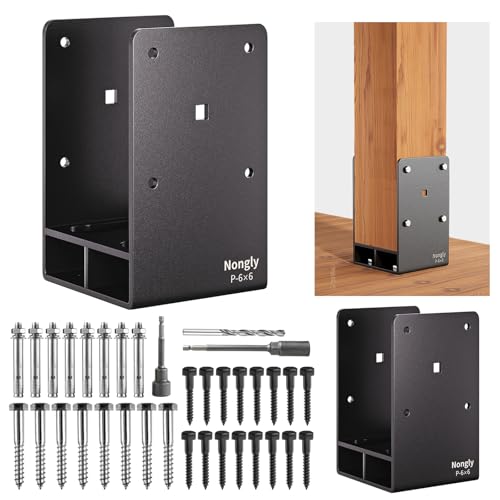
STRONG AND STURDY: The deck post base is made of thickened stainless steel with a seamless welding process. It has excellent wear and fracture resistance. The black powder coating gives anti-corrosion and anti-rust protection.

Robust Mounting Solution To Anchor Wood Newel Posts Directly To Ground: The complete set includes four 11" long lag bolt, one set of heavy-duty metal nuts, four semicircular aluminum alloy piece, and eight round red oak plugs. You no additional parts need to be purchased.
Tools and Materials You’ll Need
Successfully notching posts requires assembling the right combination of cutting tools, measuring instruments, fastening hardware, safety equipment, and finishing materials before you begin your installation work. You’ll need a circular saw, jigsaw, and oscillating multi-tool for your primary notching techniques. A table saw guarantees precise straight cuts, while an angle grinder smooths finished edges. Measuring accurately demands a tape measure, framing square, and combination square. For fastening, gather ½-inch through bolts, carriage bolts, and structural wood screws rated for treated lumber. Don’t overlook safety gear—glasses, gloves, respirator, and hearing protection are essential. Regular tool maintenance keeps your equipment sharp and functional throughout the project. Finally, stock post caps, approved wood preservative, and bracing lumber for complete installation support. Professional staining services often include railing finishing costs that may range from labor costs for railings, so budget accordingly for the complete deck system. Ensure your posts are spaced according to building code requirements to maintain structural integrity and safety compliance throughout your railing system.
Step-by-Step Fastening Methods
Once you’ve notched your posts to fit properly, you’ll need to secure them to your deck structure using one of several fastening approaches. For surface mounting, use ½-inch through-bolts positioned 1¾ inches from joist edges, then inspect and tighten every six months. Fascia mounting preserves deck space by attaching posts to the rim joist with lag bolts or through-bolts into blocking. For post reinforcement, consider steel connectors like Simpson Strong-Tie systems, which you’ll fasten with ¼ x 1½-inch wood screws and through-bolts. Before finalizing your fastening method, verify that your posts are leveled and checked for vertical plumb to ensure proper railing installation and safety compliance. As an alternative fastening method, timber screws provide quick, strong connections when pre-drilled to prevent splitting. All hardware must be hot-dipped galvanized or polymer-coated for corrosion resistance with pressure-treated lumber. Following local building codes for spacing will ensure your installation meets safety standards and passes inspection.

PRECISE 3/8" x 8" SIZE FOR STRUCTURAL USE 3/8 inch diameter and 8 inch length designed for heavy-duty wood-to-wood connections where deep embedment and strong holding power are required.

20 Pack - Made from heavy-duty 2 mm thick durable steel - 14 gauge

Durable Outdoor Finish — Designed for Long-Term Use: Crafted for outdoor railing applications with a textured matte black finish designed to resist everyday wear and maintain a clean appearance across deck, porch, and stair railing systems.
Installing Posts Before Decking
Before you lay a single decking board, you’ll need to install your railing posts on the rim and end joists where they’re most accessible and visually clean. Mark post locations directly on the joists using chalk lines and a measuring tape, maintaining post spacing of 6 feet apart for wood railings—verify local codes and manufacturer guidelines for composite or metal options.
Drill pilot holes through the joist and into each post to prevent splitting, then secure them with exterior-grade screws or through-bolts at least 3 inches long. Clamp posts plumb during installation to maintain alignment. Account for decking thickness when calculating final post height, ensuring railings extend at least 36 inches above the finished surface. Subtract the decking material thickness from your total post length to achieve proper compliance and appearance. For optimal protection after installation, plan to apply wood stain coverage at an appropriate rate to ensure your posts and railing system maintain weather resistance and durability. For added durability and weather resistance, consider specialized hardware similar to what’s used in pergola construction to create a more secure and long-lasting installation.

137PCS 3-INCH DECK SCREWS: The 2-pound package includes approximately 137 pieces of #10 x 3-inch deck screws and one matching T25 star drive bit. A practical exterior wood screw set for decks, fences, framing and general outdoor construction projects.

🔩🔩🔩Sturdy Construction: These square post bases are made of heavy-duty stainless steel for long-lasting durability and corrosion resistance.

【Important – Designed ONLY for 4x4 & 3.5x3.5 Posts】Kolpop solar post cap light is made to fit 4x4 inch and 3.5x3.5 inch wood or vinyl post caps.❌ DOES NOT fit any other sizes – including posts smaller than 3.5" or larger than 4.0"📏 Quick check: If your post is not exactly 3.5" or 4.0", this solar post light will NOT fit – verify your post dimensions before purchase
Ensuring Code Compliance and Safety
Because building codes vary greatly by location, you’ll need to verify your local requirements before finalizing your railing design. Contact your building department to confirm height specifications—many states mandate 42 inches minimum, exceeding the IRC’s standard 36 inches. You’ll also need to confirm load requirements, baluster spacing limits, and post spacing regulations for your jurisdiction.
Before installation, guarantee your posts are plumb and properly fastened using carriage bolts or structural screws. Ensure that baluster openings do not allow passage of a 4-inch diameter sphere to prevent falls. Inspect all notches to confirm they maintain structural integrity without compromising load capacity. When fastening components, use pre-drilling holes slightly larger than screw diameter to avoid cracking the wood, similar to techniques used in polycarbonate panel installation. Once installed, implement post maintenance tips by regularly checking fasteners for loosening and inspecting for rot or damage.
Following these compliance steps protects your family while preserving deck railing aesthetics and longevity.

DIMENSIONS & SUPERIOR STRENGTH: Thread Diameter 0.25" - Head Diameter 0.55" - Length 3" - Use with T30 Star Bit. Crafted from heat treated steel, LIONMAX heavy duty lag screws offer unmatched strength and reliability for long-lasting woodworking projects

DIMENSIONS & SUPERIOR STRENGTH: Thread Diameter 0.25" - Head Diameter 0.55" - Length 4" - Use with T30 Star Bit. Crafted from heat treated steel, LIONMAX heavy duty lag screws offer unmatched strength and reliability for long-lasting woodworking projects

【DIMENSIONS】Length: 3" (75mm), Diameter: #14 (6.35mm). These wood screws are designed for use with a T30 star drive bit for fast, stable installation.