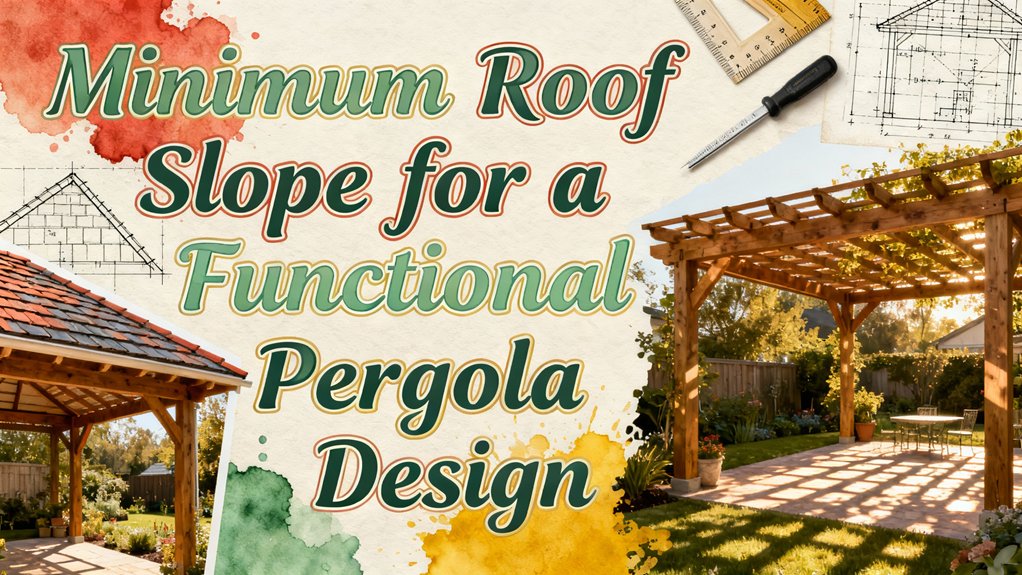
Minimum Roof Slope for a Functional Pergola Design
You’ll need a minimum slope of 5–10 degrees for your pergola roof to prevent water pooling and structural damage. A practical baseline is 1 inch drop per 12 inches of horizontal length, though residential standards typically range from 1/4 to 1/2 inch per linear foot. Your specific slope depends on your climate zone, roofing material, and local rainfall intensity. Heavy precipitation zones require steeper 8–10 degree slopes, while moderate regions function well at 6–8 degrees. Understanding how these factors interact reveals the complete picture for your design.
Industry-Standard Slope Requirements for Pergolas
Because water pooling causes long-term structural damage, you’ll need to incorporate a minimum 5-10 degree slope into any pergola roof design—even those with a flat appearance. This translates to approximately 1 inch of drop per 12 inches of horizontal length, establishing your baseline slope specifications for proper drainage efficiency.
You’ll find that a 1/4 inch to 1/2 inch drop per linear foot represents the preferred residential standard. The 1/4 inch per foot grade—classified as a 2% to 4% slope—provides adequate drainage without compromising visual balance. However, heavy rainfall regions justify steeper 1/2 inch per foot grades to manage increased water volume effectively. When planning your pergola installation, allocate adequate clearance space around the structure to ensure proper maintenance access and visual proportion with your home.
These industry standards guarantee you maintain both functionality and aesthetic appeal while preventing leaks and structural deterioration. Different roofing materials and styles, such as aluminum, polycarbonate, and metal options, may have specific slope requirements to optimize their performance and longevity.

Upgrage 3-Way Right Corner Brackets: Our Grehitk pergola brackets are extended 3-Way right angle corner bracket. It has enhanced the stability of the pergola, even in inclement weather. The 4x4 pergola brackets post features weather-proof performance and a stable frame, so you do not have to worry about the attack and damage to storms and wind.

Durable Material :4x4 brackets for wood posts are anti-rust,anti-corrosion, and water resistant. It can ensure you years of use.

Durable Material : Roof riser brackets for patio cover are anti-rust,anti-corrosion, and water resistant. It can ensure you years of use
Material-Specific Considerations for Roof Pitch
While industry standards establish baseline slope requirements, your material choice fundamentally determines the best pitch for your pergola roof. Polycarbonate and metal roofing systems perform most effectively at 1:12 slope, leveraging smooth surfaces for efficient drainage techniques. Glass panels demand steeper 10-degree slopes to prevent water streaking and protect seals. Fabric covers require aggressive 15-degree pitches to counteract sagging under water weight. Conversely, wood lattice structures tolerate gentler slopes since their open design naturally facilitates water passage through gaps. Similar to how proper railing height must meet local building codes, your pergola slope should comply with regional structural requirements for optimal safety and performance.
Your material selection directly impacts maintenance demands and longevity. Solid materials benefit from drainage techniques emphasizing rapid runoff prevention, while permeable structures eliminate ponding concerns entirely. Beyond structural considerations, the right slope enhances your pergola’s ability to extend living areas by ensuring reliable weather protection year-round. Match your chosen material’s drainage properties to appropriate slope specifications for reliable performance.

Polycarbonate Roofing Panels: Transparent roofing panels made from polycarbonate material, 1mm thick, offering transparency comparable to glass. Features waterproofing, thermal insulation, anti-aging, and impact resistance

Versatile Applications Outdoors Greenhouse Panels: These Pergola Greenhouse Roof Panels are suitable for a wide range of uses, including greenhouses, swimming pool enclosures, garages, outdoor canopies, garden fences, and sunrooms. also an ideal choice for outdoor chicken coops, farms, and other agricultural or industrial facilities
Polycarbonate Roofing Panels: Transparent roofing panels made from polycarbonate material, 1mm thick, offering transparency comparable to glass. Features waterproofing, thermal insulation, anti-aging, and impact resistance
Climate and Weather Impact on Drainage Design
Your local climate fundamentally shapes the minimum roof slope your pergola requires, as rainfall intensity, seasonal precipitation patterns, and temperature fluctuations directly influence both drainage capacity and material performance. In heavy rainfall zones, you’ll need slopes of 8–10 degrees (1:6 ratio) for efficient water discharge and climate adaptation. Moderate areas benefit from 6–8 degree slopes, while light rain regions function adequately with 5–6 degrees. For weather resilience in freeze-thaw climates, slopes exceeding 10 degrees prevent ice dams and snow accumulation. Temperature variations amplify material stress through expansion and contraction cycles, making rapid drainage critical to minimize water retention and freeze damage. You must assess local wind patterns and prevailing weather conditions to optimize slope orientation, ensuring your pergola withstands seasonal challenges effectively. Before finalizing your design, verify that your pergola meets structural requirements outlined in your local building codes. In regions prone to extreme weather such as hurricane zones, serious engineering and consultation with local building authorities are essential to ensure your pergola design meets all regulatory and safety requirements.
Pergola Size and Configuration Factors
Once you’ve determined the ideal roof slope for your climate’s drainage needs, you’ll focus on sizing and configuring the pergola structure itself—decisions that directly impact both functionality and structural integrity.
Pergola scaling requires proportional relationships between dimensions. Maintain a height-to-width ratio of 75-80% for balanced design aesthetics—a 10-foot-wide structure calls for 7.5-8 feet of height. Post spacing shouldn’t exceed 10 feet, guaranteeing stability without excessive lumber requirements. Depth should meet minimum standards of 2 feet, though deeper configurations (10+ feet) better accommodate dining or lounging areas. Before finalizing your pergola design, verify that your structure complies with zoning permit requirements in your municipality, as sizing regulations may affect your project timeline.
You’ll align these proportions with your patio’s dimensions while preserving 3 feet of clearance around the structure. For maximum durability, anchor vertical posts with heavy-duty post base brackets secured into concrete footings to ensure long-term stability. This calibrated approach guarantees your pergola integrates seamlessly with existing architecture while delivering reliable performance and visual harmony.
Installation Methods for Achieving Proper Slope
Several proven installation methods can achieve the proper roof slope your pergola requires for ideal drainage and warranty compliance. Your shim choices include door stop shims for cost-effectiveness, lateral shims spaced every 24″-30″ for hidden adjustment, or tapered furring strips for retrofitting flat structures. You can raise support posts incrementally using stacked boards to create natural slope without modifying rafters. Slope adjustments via tapered furring strips demand precise cutting—typically 1/16″ to 1/8″ per linear foot—ensuring consistent angle. For panel installation, you’ll orient grooves downhill and start placement from the highest point, maintaining proper overlap. Install cross supports every 2-3 feet for structural integrity. Verify your slope meets manufacturer minimums: Hercules requires 0.25″ per 12″, while Apollo demands 0.5″ per 12″. Like outdoor wooden furniture, pergola materials benefit from finishes formulated to withstand UV rays and moisture to ensure long-term durability and weather resistance.
Maintenance Benefits of Adequate Roof Pitch
Installing proper roof pitch isn’t merely about meeting manufacturer specifications—it directly impacts your long-term maintenance requirements. You’ll notice reduced cleaning frequency with adequate slope; studies show sloped roofs need up to 50% less manual cleaning compared to flat alternatives. Natural runoff eliminates debris accumulation that standing water attracts on flat surfaces.
Mold prevention becomes greatly easier with proper pitch. You’ll experience faster material drying after rainfall, limiting conditions favorable for microbial growth. This extended maintenance interval protects both aesthetics and structural integrity. Just as proper surface preparation ensures stain adhesion and longevity on wooden structures, adequate pergola pitch prevents moisture-related degradation by promoting proper drainage and drying. Maintaining clear drainage paths and gutters throughout winter months further prevents water backup that can compromise your structure.
Beyond cleanliness, adequate pitch reduces your water infiltration risks. You’ll avoid costly structural repairs from prolonged moisture exposure, which accelerates material degradation on wood, metal, and polycarbonate surfaces. Ultimately, proper slope minimizes your long-term maintenance costs while extending your pergola’s lifespan considerably.

Durable Material : Roof riser brackets for patio cover are anti-rust,anti-corrosion, and water resistant. It can ensure you years of use.

Complete Kit, Simple Setup: Get everything you need in one box—3 heavy-duty roof riser brackets and all necessary mounting hardware; Featuring a U-shaped saddle and a convenient half-open design, these brackets effortlessly accommodate different lumber width for a straightforward, tool-friendly installation of pergolas, patio covers, and gazebos

HIGH-QUALITY MATERIAL: Made of high-quality 304 stainless steel combined with electrostatic painting process will make the product more sturdy and durable. In addition, the product is not easy to corrode or peel off in bad weather conditions, so there is no need to worry about the weather.
Optimizing Drainage Efficiency and Longevity
While aesthetic considerations matter, your pergola’s drainage performance ultimately determines its structural longevity and maintenance burden. Drainage optimization hinges on understanding water flow dynamics—even subtle slopes create gravitational acceleration that prevents ponding and debris accumulation. Water velocity increases exponentially with slope; insufficient pitch causes stagnation, while excessive steepness generates noise and seal wear in retractable systems.
You’ll achieve ideal balance by matching slope to your climate. Heavy precipitation zones demand 8–10 degrees (~1:6 ratio), moderate rainfall areas perform well at 6–8 degrees, and snow-prone regions require slopes exceeding 10 degrees to mitigate ice dam risks. Proper gutter sizing complements your roof slope, ensuring runoff management during intense storms. Strategic drainage channels water away from foundations, preventing deterioration and maximizing your pergola’s lifespan. Planning your pergola’s drainage system should factor into your overall project budget, as inadequate water management can lead to costly repairs down the line.

Premium 2.5mm Reinforced Steel Construction:Crafted from upgraded 2.5mm thick galvanized steel (thicker and stronger than standard 2mm market brackets), these pergola brackets deliver enhanced structural integrity and long-term durability. The extended 5.9-inch design provides greater support surface and improved weight distribution, ensuring a more stable and secure pergola structure for heavy-duty outdoor projects.

High Strength, roof brackets for patio cover comes made of stainless steel metal and surface fully covered black powder coating, strong and stable for a long lasting time, even in the storm weather, the patio roof cover still can stand outdoors stably
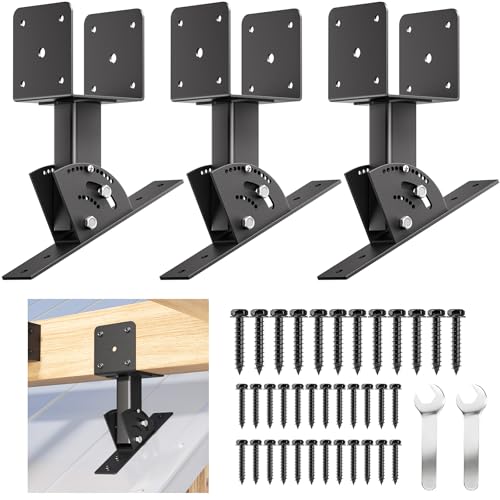
ROOF RISE BRACKET: Roof rise brackets securely anchor pergolas, patio covers, or sunshades to rooftops. Elevate your outdoor space. Perfect for DIY enthusiasts.