The Ultimate Guide to Installing Composite Deck Boards
You’ll need to establish precise dimensions, secure permits, and inspect soil conditions before starting. Gather power tools, composite screws, and hidden fastener clips for installation. Use hidden clip systems with proper 3/16-inch spacing and guarantee screws penetrate one inch into joists. Maintain 35mm clearance beneath boards for airflow. Stagger joints, account for expansion gaps based on temperature, and conduct annual inspections. The details that’ll transform your deck into a durable, long-lasting investment await you.
Preparation and Planning
Before you’ll need to establish a solid foundation through careful preparation and planning. Start by determining your deck’s precise dimensions and calculating total square footage for accurate material ordering. Review local building aesthetics standards and outdoor regulations to guarantee compliance with setback requirements and property boundaries. Secure all necessary permits before commencing construction to avoid delays or legal issues. Next, remove vegetation, rocks, and debris from your installation area, creating a clean, level surface. Mark out the deck perimeter and plan adequate drainage to prevent water accumulation. Finally, inspect soil conditions to determine your ideal foundation method. Ensure your framing uses appropriate joist sizes such as 2×6 through 2×12 lumber, selected based on span and load requirements as specified in local building codes. For composite decking installations, plan your joist spacing to not exceed 16 inches on center to properly support your deck boards and hidden fastener systems. This thorough preparation phase prevents costly mistakes and guarantees your composite deck installation proceeds smoothly and meets all regulatory requirements.
Tools and Materials Required
To successfully install composite deck boards, you’ll need to assemble a thorough collection of power tools, measuring instruments, fasteners, foundation materials, and safety equipment. Your tool selection should include a circular saw with fine-toothed blade, power drill/driver, miter saw, and jigsaw for various cutting tasks. Measuring tools like tape measures, chalk lines, and laser levels guarantee precision. Material types encompass composite deck screws, hidden fastener clips, pressure-treated joists, joist tape, concrete blocks, and post anchors. Don’t overlook spacing guides for maintaining proper expansion gaps. When using hidden fasteners, ensure you have Trex Hideaway start clips specifically designed to secure your first deck board while maintaining the seamless appearance throughout installation. For grooved decking boards, side-groove fasteners inserted into the board grooves create a fastener-free look on the surface while maintaining structural integrity. Safety equipment—including goggles, gloves, and ear protection—protects you during installation. Bar clamps and rubber mallets assist with board positioning. Gathering these components beforehand streamlines your installation process and prevents mid-project delays.
Fastening and Installation Techniques
Several fastening methods exist for composite deck board installation, each offering distinct advantages depending on your aesthetic preferences and project requirements. You’ll choose from top-down fasteners, hidden clip systems, and plug options—each representing different installation principles tailored to grooved or solid composite boards.
Hidden clip fasteners conceal hardware entirely between grooved boards, maintaining uniform 3/16-inch spacing throughout installation. You’ll insert fasteners at every joist location before sliding subsequent boards into position. Alternatively, color-matched screws coordinate with board colors for a cohesive appearance when used along perimeter edges. Proper board spacing ensures adequate water drainage and ventilation beneath your composite deck system.
Your installation sequence begins with color-matched screws near the house structure, followed by hidden fastener placement. You’ll use camo levers after approximately four rows to guarantee proper compression and alignment. For optimal fastening performance, ensure that screws penetrate at least one inch into the underlying joist structure to provide a secure hold. Consulting manufacturer guidelines guarantees compatibility between your specific fastener types and board systems.
Layout Patterns and Board Orientation
After you’ve secured your fastening system, you’ll need to determine which layout pattern best suits your project’s aesthetic goals and structural requirements. Your pattern selection greatly impacts both installation complexity and visual appeal.
The single-width horizontal pattern offers the most economical approach, utilizing standard 16-inch on-center spacing for straightforward installation. For enhanced visual interest, consider chevron or herringbone patterns, which employ 45-degree angled cuts to create geometric sophistication. These require more precision but deliver striking results.
Transition boards and picture frame patterns provide versatile deck design solutions, establishing visual separation between functional areas while maintaining structural integrity. Transition boards run perpendicular to primary boards, whereas geometric tile patterns incorporate framed inlays with contrasting orientations. Unlike pressure-treated wood decking that requires minimal initial spacing to accommodate natural shrinkage, composite boards need proper drainage and ventilation considerations built into your layout design.
Select your pattern based on budget constraints, installation expertise, and desired aesthetic impact before beginning board placement. Proper wood grain direction consideration during layout helps ensure optimal water drainage and long-term durability of your composite deck.
Cutting, Measuring, and Handling Boards
Precise cutting and careful handling are foundational to successful composite deck installation, as measurement errors and improper techniques directly compromise both structural performance and visual quality. You’ll measure twice before marking to eliminate costly mistakes. Use a speed square and pencil for accurate cut lines across the board’s entire width.
Select the appropriate saw for your cutting techniques: miter saws for crosscuts and angles, circular saws for straight cuts, and jigsaws for curved edges. Always support boards at both ends during cutting to prevent sagging. Cut with the textured side up to minimize chipping, and let the blade reach full speed before starting. Use fine-tooth carbide-tipped blades to ensure clean, professional cuts without splintering.
For board handling, store composite decking flat away from direct sunlight before installation. Keep boards off the ground to prevent moisture absorption, and install them quickly after cutting to minimize expansion and contraction issues. Maintaining proper board spacing throughout the installation process ensures adequate air circulation and prevents warping over time.

SPECIFICATION: Diameter: 5-1/2 inch circular saw blade(140 mm); Arbor size: 10 mm; Max Rpm:8000; Carbide Teeth: 24T&48T

Application - Designed for cutting wood, suitable for all kinds of softwood, hardwood, multilayer, MDF, plywood, laminate, chipboard, and so on. Wood with nails can also be cut
Maintenance and Troubleshooting Tips
Once you’ve installed your composite deck boards with precision and care, your work isn’t complete—you’ll need to establish a maintenance routine to preserve the deck’s appearance and structural integrity for years to come. Implement regular cleaning techniques using a soft-bristle brush with warm soapy water to address stubborn stains without damaging the surface. Sweep debris frequently to prevent drainage obstruction and staining. For mold prevention, guarantee adequate airflow and sunlight exposure in shaded areas. Remove organic matter promptly, as leaves and sticks trap moisture. Conduct annual inspections to identify loose fasteners or damaged boards. Address spills immediately, especially grease or oil. Use low-pressure washing only when necessary, maintaining at least ten inches from the surface. To prevent residue buildup and film formation on your composite boards, thoroughly rinse the deck after applying any cleaning solution. Consider installing under-deck drainage systems to divert water away from the substructure and enhance long-term durability. Tighten fixtures and contact professionals for significant repairs.
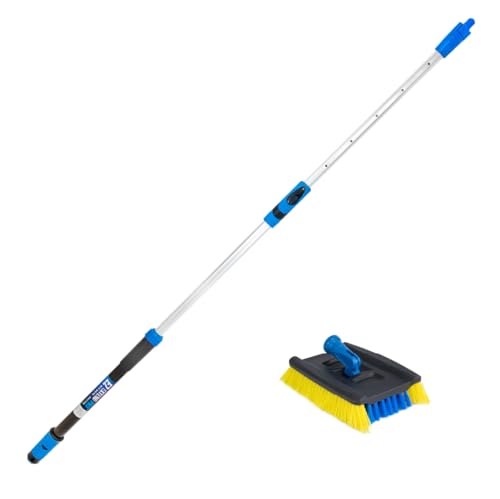
COMPLETE DECK CLEANING TOOL: The professional-grade deck brush with extendable pole is all you need to clean your deck with less effort and better results

Dual-Bristle Construction: The only deck brush to effectively clean both deck boards and seams at once! With Unger Professional's Wood & Composite Deck Brush, one tool is all you need to thoroughly clean your standard sized deck with ease

Yocada Deck Brush with 4-Section Extendable Handle Floor Scrub Brush: Sturdy PP bristles resist deformation and reinforced handle joints ensure long term durability even with frequent use. The 9.8 inch yellow brush head features soft medium bristles designed to lift dirt, leaves from wood, composite, or concrete surfaces without scratching. Whether you’re maintaining a deck, driveway, or garage floor, this brush delivers heavy-duty cleaning power with minimal effort
Best Practices for Long-Term Deck Performance
Because composite decking expands and contracts with temperature changes, you’ll need to establish foundational practices that accommodate this movement while maintaining structural integrity. Plan expansion gaps based on your climate considerations: 1mm above 26°C, 3mm between 4–25°C, and 6mm below 4°C. Lock boards in the middle to allow even expansion on both ends.
Maintain proper joist spacing at 250–350mm apart and use composite-compatible fasteners to prevent corrosion. Space hidden fasteners 16 inches on center for consistent support. Guarantee a 35mm clearance beneath boards for airflow and drainage, which prevents moisture buildup and extends deck life. When using hidden fastening systems, position fasteners at specified intervals along the joists to ensure proper board engagement and a fastener-free surface appearance.
These sustainable materials require meticulous installation protocols. Stagger board joints, use double joists for spans exceeding 3.6m, and monitor alignment throughout installation. Before beginning your composite deck installation, check with your local municipality to understand any building permit requirements that may apply to your project. Following these practices maximizes your investment’s longevity.