Building a Pergola: What’s the Maximum 4×4 Span?
You can safely span a 4×4 post between 6 to 8 feet without support, though this depends on load classification, environmental conditions, and connection hardware. Wind and snow loads greatly impact maximum spans—moderate wind zones reduce safe spans to 8 feet. For unsupported spans exceeding 13.8 feet, structural integrity becomes compromised. You’ll need to calculate your specific dead and live loads, consider local building codes requiring 1.5–2.0 safety factors, and potentially upgrade to 6×6 posts for heights beyond 8 feet. The details of optimizing your exact configuration reveal critical structural considerations.
Standard Maximum Span for 4×4 Posts
Four structural factors determine your 4×4 post‘s maximum span: a 4×4 post typically supports unsupported beam spans of 6 to 8 feet, contingent on load classification, environmental conditions, and connection hardware. You’ll find that 4×4 limitations become apparent when you exceed these thresholds without intermediate support.
Load factors directly influence your design calculations. Dead loads—including beam weight and roofing materials—combine with live loads from snow, wind, or climbing vegetation to reduce feasible span capacity. You must account for these cumulative forces when determining post placement.
Environmental conditions further constrain your options. High-wind zones or heavy-snow climates demand sturdier posts, typically 6×6 members. You’ll strengthen connections near the upper span limit by installing quality pergola brackets and hardware. Unsupported spans longer than roughly 13.8 feet risk sagging or warping without central posts or additional bracing. For comparison, double 2×12 beams can span up to 17 to 18 feet, demonstrating how beam material choice significantly affects overall pergola design possibilities.
For residential pergolas carrying moderate loads under standard conditions, you’ll achieve ideal structural integrity by maintaining spans between 6 and 8 feet.

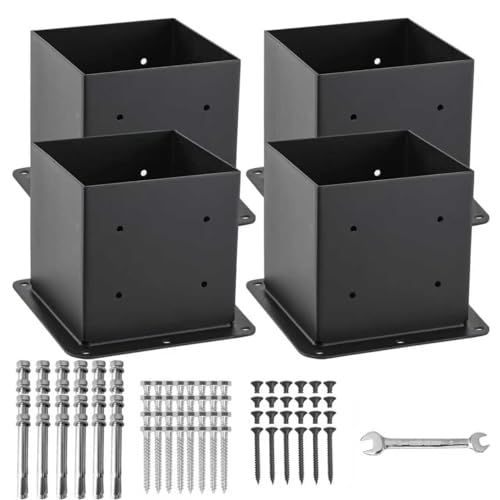
Heavy Quality Steel Construction: The pergola Bracket kit is made of 2mm thick Q235B high-quality steel, high-strength welded structure, no deformation. Black outdoor powder coating, solid and durable, anti-corrosion and rust prevention

4" x 4" Four-Way Pergola Brackets: This durable and strong pergola bracket kit that covers wooden beams, preventing them from rotting due to rainwater and harsh sunlight. It is designed for the mainstream 4" x 4" specifications and can accommodate actual dimensions of 3.6 x 3.6 inches (92 x 92 mm) for both soft and hardwood.

T-shaped Support - The inner diameter width of our pergola brackets extension kit is 3.57 inches, suitable for 4×4 railing posts (Please note that the actual product size is 3.57" × 3.57"). The support length is 5.9 inches, with sufficient length to support your wooden beams. The height of the support is not capped, and it can be used for higher wooden beams
Understanding the Span and Post Size Relationship
Now that you’ve established 4×4 posts support 6 to 8 feet under standard conditions, you’ll need to understand how span and post size interact across varying load scenarios. Your post material directly influences structural integrity—cedar, pine, and treated lumber each exhibit different strength characteristics. When you increase span length, bending forces escalate dramatically, often exceeding post capacity without reinforcement. You’re working with a critical relationship: every additional foot of span multiplies lateral stress exponentially. Aluminum posts offer superior strength-to-weight ratios but rarely extend beyond 10 feet safely. Engineered or laminated alternatives may perform better than solid 4x4s. You’ll calculate load distribution by analyzing uniform versus point loads, determining whether your specific materials maintain structural integrity under your pergola’s actual weight demands and environmental conditions. A well-designed pergola can enhance garden aesthetics while providing the structural support necessary for long-term stability. Just as proper railing height requirements ensure safety in deck installations, establishing correct post spacing and span distances protects the structural integrity of your pergola design.
How Pergola Height Affects Structural Requirements
As you scale your pergola vertically, you’re fundamentally altering the structural demands on every component—posts, beams, rafters, and connections all must compensate for increased bending moments and lateral forces. Height considerations directly determine whether your 4×4 posts remain adequate or require upsizing to 6×6 specifications.
For pergolas exceeding 10 feet, you’ll need to upgrade beam dimensions from 2×8 to 2×10 or 2×12 to maintain structural integrity. Rafters similarly demand enhancement from 2×6 to 2×8 for extended spans. Your footing depths must increase 2–3 feet for taller structures, with concrete extending below the frost line in cold climates.
Connection strength becomes critical. Replace nails with bolts or lag screws, employing metal connectors rated for higher loads. If adding a polycarbonate roof, ensure your metal connectors and fastening methods are rated for the additional load of roofing panels and thermal expansion stresses. Engineering calculations become mandatory for heights surpassing 12 feet, ensuring your pergola withstands environmental stresses reliably. Most jurisdictions require that taller pergolas meet structural requirements outlined in local building codes to ensure safety and compliance.

Sturdy Material: Pergola bracket is made of high quality carbon steel, which has excellent wear resistance, corrosion resistance, and rust resistance, effectively extending the service life of the steel support frame of the pergola kit. You can use this high-quality material frame to build a stable pergola for family gatherings.

6" x 6" Four-Way Pergola Brackets: This durable pergola bracket covers wooden beams, preventing them from rotting due to rainwater and harsh sunlight. It's designed for mainstream 6"x6" specifications and can accommodate actual dimensions of 5.6x5.6 in (142x142 mm) for both soft and hardwood.Enhanced Durability: Constructed from 2mm Carbon Steel Plates with Black Powder Coating for Corrosion Resistance. Reinforced 90° Boot Structure Prevents Breakage and Deformation, Ensuring Stability.

1" STANDOFF DESIGN FOR WOOD PROTECTION: Elevates your 5.5x5.5 wood post a full 1 inch above concrete. This ventilation gap prevents moisture buildup, reduces wood rot, and extends the life of your 6x6 post base for concrete. Simple design, big impact for pergola bracket kit longevity.
Environmental Factors: Wind and Snow Load Considerations
While height and materials form your pergola’s foundational strength, environmental stressors—particularly wind and snow—directly constrain what span distances you can safely support with your chosen post size. You’ll reduce your 4×4 span from 10 feet to 8 feet in moderate wind zones, and further in coastal areas where wind resistance demands structural conservatism. Snow accumulation proves equally critical: light loads under 10 lbs/sq ft permit 10-foot spans, but moderate zones (10–20 lbs/sq ft) cap you at 8 feet. Wind speeds exceeding 90 mph eliminate 4×4 posts entirely. You must calculate your specific regional load requirements—building codes mandate safety factors of 1.5–2.0 for outdoor structures, similar to how local building codes guide deck railing installations to ensure safe construction. For comparison, 6×6 beams can typically span 12 to 18 feet when properly engineered, demonstrating how post size significantly affects maximum span capability. Permits often require engineering calculations for spans over 8 feet in harsh climates, ensuring structural compliance and preventing costly failures.
Optimizing Rafter and Beam Spacing for Stability
You’ll optimize rafter load distribution by spacing members 16 inches on center rather than 24 inches, which reduces deflection considerably. This closer spacing distributes weight more evenly across your structure. For 2×6 rafters, you can achieve spans up to 14 feet with proper support.
Implement beam reinforcement techniques by doubling 2×10 lumber and bolting them together when spanning near 12 feet with 4×4 posts. Confirm adequate bearing surfaces and avoid excessive overhang. Match beam depth to span length—longer spans demand 2×10 or 2×12 sizing. A typical 4×6 wood beam should span no more than about 6 feet between posts to maintain structural integrity and prevent sagging. Proper connection hardware between posts and beams maximizes joint stability, preventing movement that compromises your entire system’s rigidity. All structural components should be securely fastened to ensure the pergola can safely support the weight of your chosen roof material.

Ultimate Durability & Superior Strength: Our hurricane straps are constructed from heavy-duty hot-dip galvanized carbon steel with a black protective coating, built to last and resist rust, corrosion, and outdoor wear. Featuring a thick 13-gauge (2.2mm) design – 80% thicker than standard 18-gauge (1.2mm) connectors – these pergola brackets deliver unmatched hardness and load-bearing capacity to keep your wooden structures stable and durable.
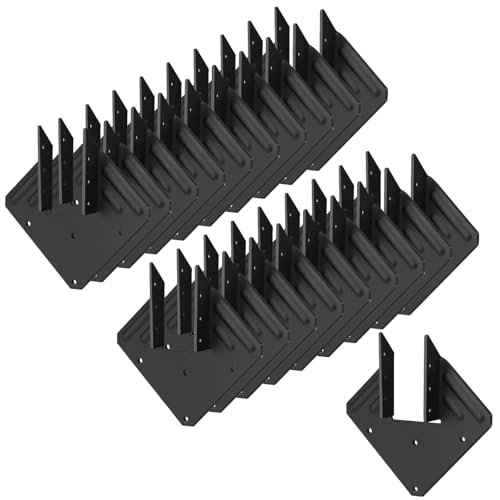
13 Gauge Hurricane Tie fits 2x4,2x6 rafters

Sturdy Joist Hangers: The concealed joist bracket is made of Q235B steel,no deformation.Black powder coated,No easy rust,sturdy and durable.
Following Manufacturer Guidelines and Kit Specifications
When you’re selecting a pergola kit, the manufacturer’s specifications aren’t suggestions—they’re structural parameters you’ll need to follow to guarantee safe performance. You’ll find that standard 4×4 kits cap spans at 12 feet maximum per section, with ideal performance occurring below 10 feet. Your kit materials include straight inline 2×4 rafters designed for specific load distributions. Rafter spacing is standardized at 18 inches apart to ensure proper load distribution across your pergola structure.
You must match post lengths—typically 8, 10, or 12 feet—to your pergola designs and mounting method. Hardware-mounted installations yield different clearance heights than in-ground placements. Consider adding adjustable shading elements such as retractable canopies or shade sails to enhance both functionality and aesthetics while maintaining structural integrity. When you exceed manufacturer guidelines, you’ll experience performance degradation and stability compromise. Professional consultation becomes essential for complex designs approaching maximum specifications, ensuring your structure maintains adequate safety margins and structural integrity throughout its lifespan.

Superior Quality Materials: This 4x4 pergola brackets feature a 90° right angle gusset plate design and weather-proof performance and a stable frame,so you do not have to worry about the attack and damage to storms and wind.

Engineered for USA Climates – ORIGLE 4x4 post brackets feature heavy-duty, corrosion-resistant steel with a premium black powder coating, ideal for pergolas, deer stand brackets 4x4, and gazebo kits in high-wind or heavy snow regions.
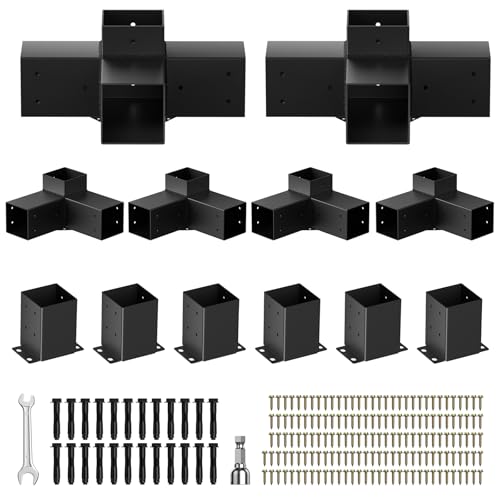
3-Way & 4-Way Pergola Brackets Kit: Upgraded 3-way & 4-way right-angle pergola brackets boost pergola stability in harsh weather. Designed for 4"x4" (actual 3.5"x3.5") sizes, the 4x4 pergola brackets are weather-resistant and sturdy, with no need to worry about storm or wind damage
When to Upgrade Beyond 4×4 Posts
As your pergola span exceeds 10 feet or your post height climbs beyond 8 feet, you’ll need to abandon the standard 4×4 configuration. Post upgrade requirements become critical when environmental factors intensify—high wind zones, significant snow loads, or seismic activity all demand larger dimensions for adequate safety margins.
Structural integrity considerations extend beyond span and height. Heavy roofing materials like solid or louvered systems concentrate substantial loads on posts, necessitating 6×6 upgrades. Poor soil conditions require enhanced footings that 4×4 posts can’t reliably support. Commercial applications almost universally mandate 6×6 or larger posts due to regulatory compliance and durability expectations. Using hidden fastening systems similar to deck installation methods can improve the aesthetic appearance and structural reliability of your pergola connections. Proper surface preparation and weather conditions during construction ensure optimal material performance and long-term durability.
Material selection influences sizing too. Aluminum pergolas typically standardize on 6.5×6.5 posts for ideal strength-to-aesthetics balance. Your design complexity—including decorative elements or additional load-bearing features—further drives post enlargement decisions.
Material Of 6x6 Post Base: Made of Solid Steel, Black Powder Coated, Rustproof and Strong.

Robust Construction: This post base features 3/16-inch thick hot dipped galvanized and powder coated steel, ensuring durability and resistance to weathering, making it ideal for your pergolas, decks, and other outdoor structures

Used for 6×6 post to attach 4x4 beam
Safety Considerations for Longer Spans
Once you’ve determined your post sizing requirements, you’ll need to validate that your beam configuration can actually handle the loads you’re imposing across your chosen span. You’ll want to apply deflection limits (L/360 standard) to guarantee your beams won’t sag excessively under load. Calculate combined dead loads—roof materials, climbing plants—plus live loads like snow accumulation. For spans exceeding 6-8 feet, you’ll need beam reinforcement through doubled lumber or strategic post placement to reduce unsupported length. Implement metal connectors and pergola brackets at all interfaces to improve joint stability. Like deck railings and structural features, your pergola must comply with local building codes that often mandate minimum requirements based on regional snow and wind conditions. This data-driven approach protects both structural integrity and structural aesthetics simultaneously.